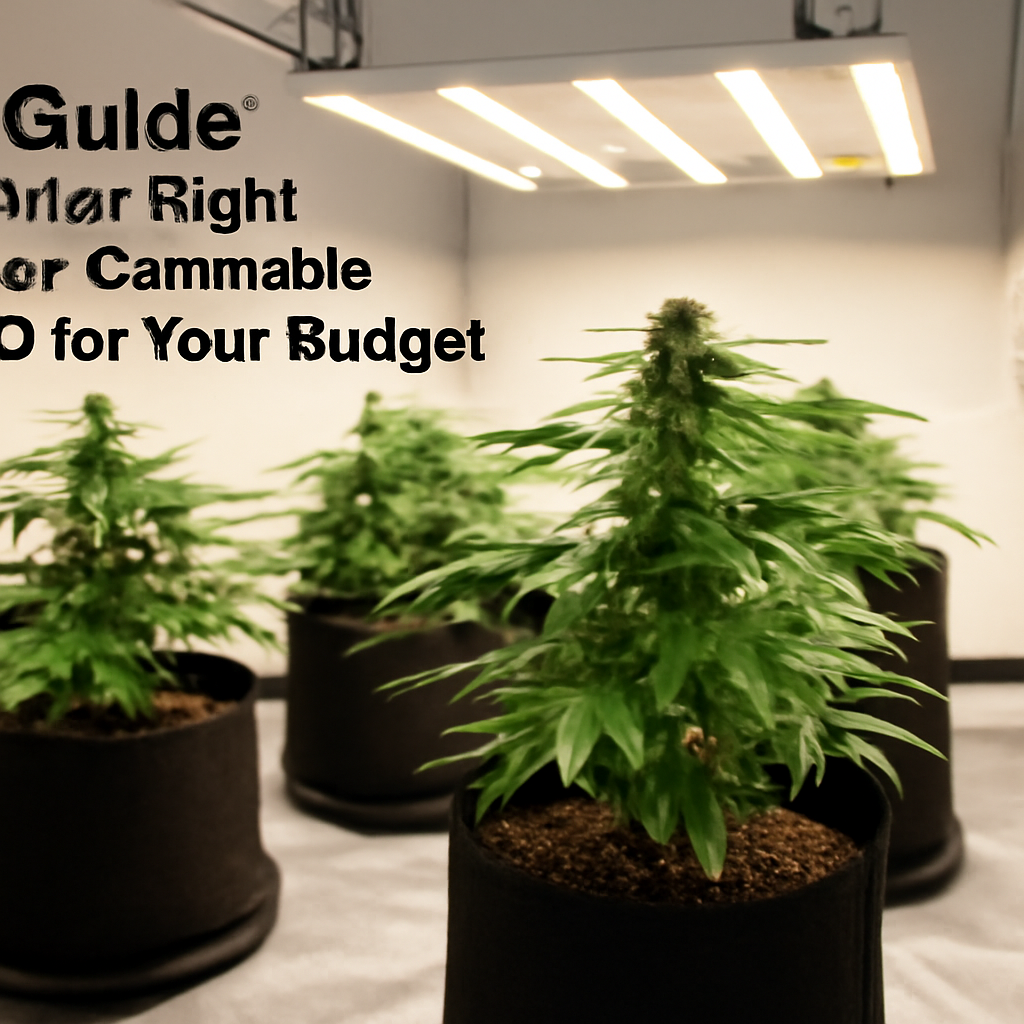
Your Complete Pot Guide to Indoor Cannabis Equipment
If you've got seeds in hand and you're trying to figure out what to actually buy before you pop them, this pot guide cuts through the marketing noise. Based on data from over 1,000 grows tracked on Grow Guide, 734 of those grows happen indoors — meaning most growers are working with tents, artificial light, and controlled environments. This guide walks you through every major equipment category, what specs actually matter, and where your money makes the most impact.
The Core Equipment Stack: What Every Indoor Grow Needs
Before getting into budget vs. premium breakdowns, here's the non-negotiable list. Skip any of these and you're gambling with your plants:
- Grow tent — light-proof, reflective interior, with ports for ducting
- Grow light — matched to your tent's square footage
- Inline fan + carbon filter — for air exchange and odor control
- Oscillating clip fan(s) — internal airflow, stem strengthening
- Thermometer/hygrometer — at canopy level, not the wall
- pH and EC meters — mandatory if you're not growing in living soil
- Timers — for lights and potentially irrigation
That's it. Everything else is optimization. Let's go through each one with specific numbers and real recommendations.
Grow Tents: Size First, Brand Second
Tent size drives every other decision. The most common starter sizes are 2×4 ft (60×120 cm) for 2–4 plants and 4×4 ft (120×120 cm) for 4–6 plants in a SOG or LST setup. Go bigger than you think you need — a cramped canopy is harder to manage and hurts airflow.
What to look for:
- 600D or higher canvas — thicker is more light-proof and durable
- Double-stitched corners — cheaper tents split here first
- Dual-cinch ports — lets you run separate intake and exhaust ducting cleanly
- Tool pouches and trellis bars — useful, not essential
Budget pick: AC Infinity CLOUDLAB 642 (2×4) — around $110. Sturdy zipper, quality canvas, and the brand plays well with their own fan controllers.
Premium pick: Secret Jardin Dark Room DR120 (4×4) — around $250. Superior light seal, heavy zippers, observation windows. Worth it if you're doing multiple cycles per year.
Grow Lights: This Is Where to Spend Your Money
Your light is the single biggest variable in your yield. A poor light in a good setup still gives poor results. The inverse isn't true — a great light compensates for a lot. Use our Grow Light Calculator to match your PPFD targets to your tent size before buying.
Target PPFD levels by stage:
- Seedling: 200–400 µmol/m²/s
- Veg: 400–600 µmol/m²/s
- Early flower: 600–900 µmol/m²/s
- Peak flower: 900–1,100 µmol/m²/s (with CO₂, up to 1,500)
What to look for in LEDs:
- Efficacy ≥ 2.5 µmol/J — this is the efficiency rating, higher is better
- Samsung LM301B/H or Osram diodes — proven diode brands used in quality fixtures
- Full-spectrum white light with UV/IR supplementation
- Dimmer control — critical for seedlings and dialing in DLI
Budget pick (2×4): Mars Hydro TS 1000 (~$100) — pulls about 150W, adequate for veg and light flower. Efficacy is closer to 2.3 µmol/J, which is fine for beginners.
Mid-range (2×4): Spider Farmer SF-2000 (~$200) — 200W, Samsung LM301B diodes, ~2.7 µmol/J. This is the sweet spot for most hobbyist grows.
Premium (4×4): HLG 600 Rspec (~$700) or Gavita Pro 1700e (~$900) — these are commercial-grade fixtures. The Gavita delivers 1,700 µmol/m²/s at 12 inches and is what many licensed producers use at canopy level.
Ventilation: The Inline Fan and Carbon Filter Setup
This pot guide's ventilation section is the one most beginners under-budget. You need to exchange the air in your tent every 1–3 minutes. For a 4×4×6.5 ft tent (~104 cubic feet), that means a fan rated for at least 100–200 CFM. Always size up — a fan running at 60% lasts longer and runs quieter than one at 100%.
Inline fan picks:
- Budget: Vivosun 4-inch inline fan (~$35) — adequate for a 2×4, noisy at full speed
- Best value: AC Infinity CLOUDLINE T4 or T6 (~$80–$120) — EC motor, near-silent, programmable speed based on temperature/humidity. This is the grower consensus pick.
- Premium: Terrabloom 6-inch with controller (~$150) — higher CFM ceiling for larger spaces
Pair your inline fan with a carbon filter rated for the same or higher CFM. Match the diameter (4-inch fan = 4-inch filter). Replace carbon filters every 12–18 months under heavy use — you'll smell when they're done.
Environmental Controls: Temperature, Humidity, and VPD
Hitting correct VPD (Vapor Pressure Deficit) is the difference between plants transpiring efficiently and plants stressing out. Here are the ranges to dial in:
- Seedling/clone: VPD 0.4–0.8 kPa, RH 65–75%, temp 75–80°F
- Veg: VPD 0.8–1.2 kPa, RH 50–70%, temp 72–82°F
- Early flower: VPD 1.0–1.5 kPa, RH 40–60%, temp 70–80°F
- Late flower: VPD 1.2–1.6 kPa, RH 30–40%, temp 68–78°F
A combo thermometer/hygrometer placed at canopy level (not on the tent wall) is mandatory. The Govee or Inkbird Bluetooth models (~$15–$25) log data to your phone, which is worth the extra $10 for catching overnight temperature drops.
For humidity management: a small ultrasonic humidifier (~$30) handles veg humidity in tents up to 4×4. For late flower, when you want to drop RH below 45%, a 70-pint dehumidifier is effective for rooms up to 10×10 ft, though overkill for a single tent — a silica gel tray or small Frigidaire unit works for single-tent grows.
The Medium Question: Soil vs. Coco
Grow Guide data shows 633 of 1,000 tracked grows use soil, with coco coir accounting for 149. Soil wins for beginners because its buffering capacity covers pH fluctuations and minor nutrient mistakes. Coco grows faster and yields more per watt, but demands more precise EC and pH management — you're essentially doing hydroponics with a solid medium.
For a full breakdown of nutrient programs by medium, see our guide on Best Nutrients for Cannabis Seedlings. If you're running coco, keep EC between 0.8–1.2 in early veg and ramp to 1.8–2.4 in peak flower. pH range: 5.8–6.2 for coco, 6.0–7.0 for soil.
A Complete Budget vs. Premium Setup Breakdown
pH and EC Meters: Don't Skip These
Of Grow Guide's 1,000 tracked grows, 547 use manual watering — which means most growers are hand-mixing nutrients every feed. A drifting pH pen that's 0.5 units off can lock out calcium, magnesium, or iron without any other visible cause. Calibrate your pH pen every 2 weeks minimum using 4.0 and 7.0 buffer solution.
If you're seeing yellowing between veins on newer growth, that's likely an iron or manganese deficiency caused by high pH — not a missing nutrient. Use the Nutrient Deficiency Identifier to cross-check symptoms before dumping extra product into your reservoir.
Harvest, Dry, and Cure: The Equipment You Actually Need
Post-harvest processing requires its own kit. For drying, you need:
- A dark space at 60–70°F and 45–55% RH
- Hangers or a drying rack — the $20–$40 mesh racks work well for small harvests
- A hygrometer in the drying space (not the tent, a separate unit)
Dry for 7–14 days until small stems snap cleanly. Then into wide-mouth mason jars at 75% fill capacity. Burp daily for the first 7 days, then every 2–3 days until you hit a stable 58–62% RH inside the jar (Boveda 62% packs help maintain this). Total cure: 4–8 weeks for significant terpene development.
Use the Dry & Cure Timer to track your drying and curing windows with automated burping reminders. It removes the guesswork on timing.
For a full indoor grow walkthrough including veg and flower timelines, see How to Grow One Cannabis Plant Indoors. If you want to track your spend against your harvest weight, run your numbers through the Cost Per Gram Calculator after your first grow.
Planning Your First Grow Schedule
Once your equipment is in place, the next step is mapping out your timeline. A standard photoperiod grow indoors runs:
- Seedling: Days 1–14 (18/6 light schedule)
- Veg: Days 14–56 (18/6, until plant is 40–50% of target final height)
- Flower: Days 56–120+ (12/12, strain dependent)
- Dry/cure: 4–10 weeks post-harvest
Use the Grow Schedule Planner to map your full cycle with date-specific reminders for flipping, flushing, and harvest. For detailed timing by grow type, see How Long to Grow Cannabis Indoors.
Frequently Asked Questions
What's the minimum budget to set up an indoor cannabis grow?
A functional 2×4 tent setup — including tent, light, fan, carbon filter, and meters — runs about $380–$425. That excludes medium, nutrients, and pots, which add roughly $50–$100. You can grow successfully at this budget; just expect to upgrade the light first when you're ready to push yield.
What size grow light do I need for a 4×4 tent?
Target 400–600 true watts of LED for a 4×4 in flower. The HLG 600 Rspec (480W) or equivalent is the benchmark. Check your fixture's PPFD map at the manufacturer's recommended hanging height — you want 800–1,000 µmol/m²/s coverage across the full canopy footprint.
How often should I calibrate my pH pen?
Every 2 weeks minimum, more often if you're mixing nutrients daily. Use fresh 4.0 and 7.0 buffer solution — solutions older than 6 months after opening give inaccurate calibration results. A $15 pen that's calibrated correctly beats a $60 pen you haven't touched in 3 months.
Do I need a dehumidifier for a single tent grow?
In most cases, no — your exhaust fan pulling air through the tent drops humidity naturally. You'll only need one if your ambient room humidity is already above 65% or during late flower when you're targeting 30–40% RH to prevent bud rot. A $30 silica gel setup handles most single-tent situations.
What's the difference between curing in glass jars vs. CVaults?
Functionally similar. Wide-mouth mason jars are cheaper and effective; CVaults use an airtight stainless steel container with a built-in Boveda pack slot, which simplifies humidity maintenance. Either works — the key variable is maintaining 58–62% RH inside the container over 4–8 weeks, not the vessel material itself.
References
- Grow Guide Platform Data (2026). Analysis of 1,000 tracked cannabis grow journals showing 734 indoor grows, 633 soil-based grows, and 547 manual-feed setups. Internal dataset, growguide.app.
- Both, A.J., et al. (2015). "An Updated Version of the ASABE Greenhouse Lighting Guideline." Transactions of the ASABE. Established foundational PPFD and DLI benchmarks still widely referenced for controlled environment cannabis cultivation. elibrary.asabe.org.
- Zheng, Y. (2020). "Cannabis Lighting: What Growers Need to Know." University of Guelph Controlled Environment Systems Research Facility. Documents the relationship between PPFD, photoperiod, and cannabis biomass accumulation. ces.uoguelph.ca.
- Small, E. (2017). Cannabis: A Complete Guide. CRC Press. Comprehensive reference on cannabis cultivation biology, nutrient physiology, and environmental management parameters including VPD and temperature ranges for optimal growth.
- Caplan, D., Dixon, M., & Zheng, Y. (2017). "Optimal Spacing of Cannabis Plants for Indoor Cultivation." HortScience, 52(11). Examined how canopy density, light intensity, and environmental parameters interact to affect yield per square meter — directly applicable to tent-based grows. doi.org/10.21273/HORTSCI12347-17.