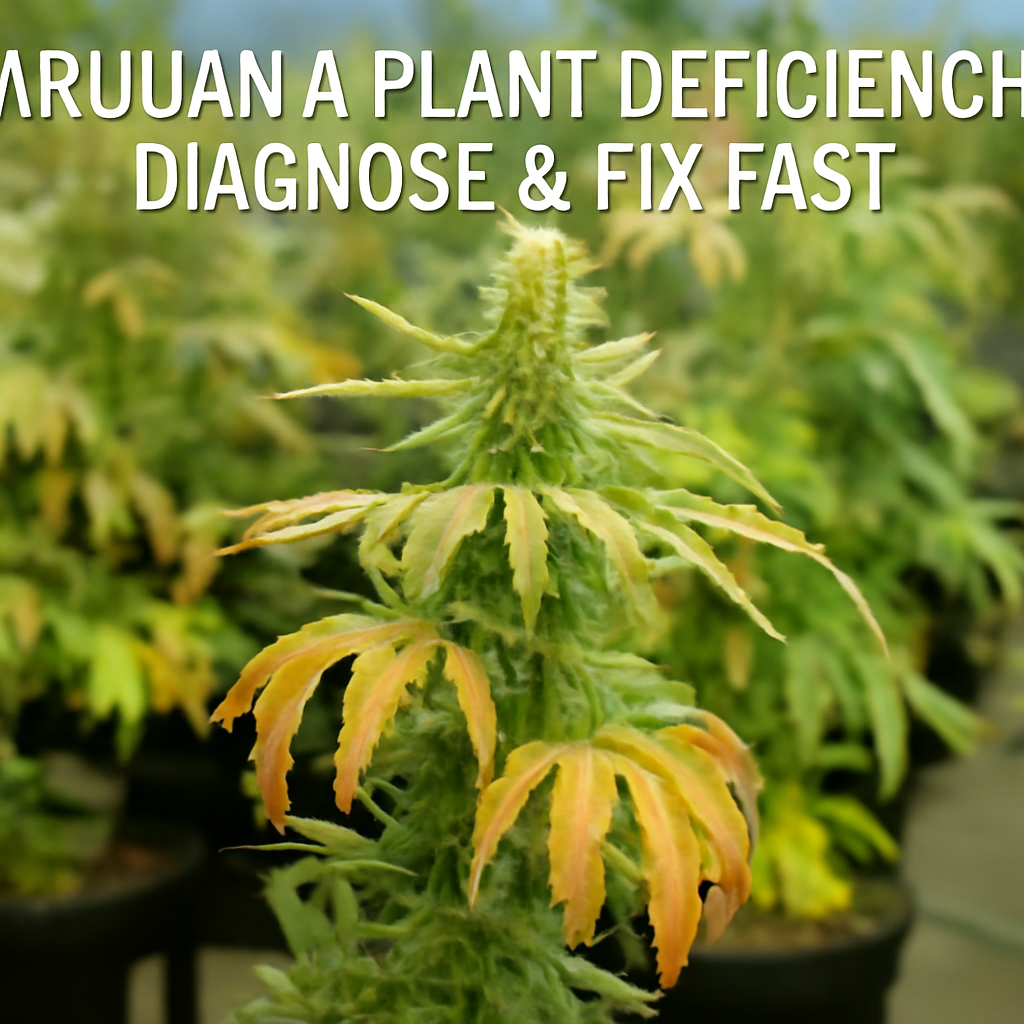
Cannabis plant deficiencies are one of the most common reasons growers panic mid-cycle — and one of the most frequently misdiagnosed. You spot yellowing leaves or purple stems and immediately reach for a bottle of cal-mag or a bloom booster, when the real culprit is a pH drift of 0.5 points locking out everything you're already feeding. This guide cuts through the guesswork: match your symptoms, find the cause, apply the fix, then lock in the prevention. If you want a faster diagnosis, use our Nutrient Deficiency Identifier — it walks you through a symptom checklist and narrows it down in under two minutes.
How to Read a Cannabis Deficiency: The Golden Rules
Before you look at any individual deficiency, apply these two rules every single time:
- Mobile vs. immobile nutrients: Mobile nutrients (Nitrogen, Phosphorus, Potassium, Magnesium) move from old growth to new growth when supply runs short — so deficiency symptoms appear on lower, older leaves first. Immobile nutrients (Calcium, Iron, Sulfur, Boron) cannot be relocated — symptoms appear on new growth and shoot tips first.
- Check pH before everything else: A healthy-looking nutrient solution means nothing if pH is wrong. At pH 7.2 in soil, iron and manganese become nearly inaccessible. At pH 5.2 in coco, calcium and magnesium uptake crashes. Correct pH first, wait 48 hours, then reassess.
The 8 Most Common Marijuana Plant Deficiencies
1. Nitrogen Deficiency (N)
What it looks like: Pale yellow-green colouring starting on the oldest, lowest leaves. Yellowing moves steadily upward. Affected leaves eventually drop. Growth slows noticeably. Common in mid-to-late veg and early flower when nitrogen demand is highest.
What causes it: Underfeeding, heavily flushed medium, or pH above 7.0 in soil reducing N availability. In coco at pH below 5.5, nitrogen uptake also suffers.
How to fix it: Flush with pH-correct water (soil: pH 6.2–6.5), then reintroduce a nitrogen-dominant feed at 50% strength — something with an NPK weighted toward N, like a 3-1-2 ratio. Feed every 2–3 days and watch for new growth greening up within 5–7 days. Don't push to 100% strength immediately; you risk tip burn.
Prevention: Keep a consistent feed schedule. During veg, target EC 1.2–2.0 in coco/hydro. In soil, use a quality base nutrient and check runoff EC to ensure the medium isn't depleted.
2. Phosphorus Deficiency (P)
What it looks like: Deep blue-green or purple-tinged leaves — often misread as a "cool" phenotype. Reddish-purple stems, especially on leaf undersides. Leaves develop brown-purple blotches and eventually curl. Most damaging in early-to-mid flower when P demand spikes.
What causes it: pH below 5.5 in any medium. Cold root zone temperatures below 60°F (15°C) — phosphorus uptake crashes when roots are cold. Excess calcium can also antagonise phosphorus at the root level.
How to fix it: Warm the root zone to 65–72°F (18–22°C). Correct pH to 6.0–6.5 (soil) or 5.8–6.2 (coco/hydro). Add a phosphorus-forward supplement — monoammonium phosphate (MAP) or a dedicated bloom booster. Foliar feeding with 0.5% strength phosphorus solution can speed recovery within 48 hours.
Prevention: Don't let your medium or reservoir drop below 65°F. In flowering, ensure your base nutrients provide adequate P before adding bud boosters that could skew the ratio.
3. Potassium Deficiency (K)
What it looks like: Brown, crispy margins ("leaf edge burn") starting on mid-canopy leaves. Tips curl upward. Leaf surface may appear dull or slightly bleached between veins. Stems weaken. Often confused with nutrient burn — the difference is that K deficiency starts at the edges of otherwise healthy-coloured leaves, while burn starts at the very tip.
What causes it: High sodium levels in water or media antagonise potassium. Excess calcium or magnesium also competes with K uptake. High EC environments can paradoxically cause K lockout despite plenty of K in the solution.
How to fix it: Flush the medium first if EC is high. Reintroduce nutrients at a balanced EC (1.6–2.2 in flower). Add a potassium sulfate supplement or use a base nutrient with stronger K weighting. Avoid adding extra cal-mag if you suspect Mg/Ca is already antagonising K.
Prevention: Know your source water's base mineral profile. High-sodium municipal water? Consider an RO system. Check feed water calcium-to-potassium ratio — general target is roughly 3:1 Ca:K in vegetative, shifting to 2:1 in flower.
4. Calcium Deficiency (Ca)
What it looks like: New growth looks distorted, crinkled or cupped. Small brown spots appear on new leaves, sometimes with a yellow halo. Growing tips may die back (tip die-off). Roots look brown and slimy in hydro. Calcium deficiency is an immobile nutrient issue — always check new growth first.
What causes it: pH below 6.0 in soil or below 5.8 in coco. Using RO or very soft water without adding a cal-mag supplement. High humidity above 75% reduces transpiration and slows calcium uptake since it's primarily transpiration-driven. In coco, calcium is easily displaced by ammonium nitrogen.
How to fix it: Raise pH to 6.2–6.5 (soil) or 6.0–6.2 (coco). Add calcium in the form of cal-mag at 5 ml/L or calcium nitrate at 1 g/L. Reduce humidity to improve transpiration. In coco, reduce ammonium-based nitrogen sources and switch to nitrate-dominant N.
Prevention: If you're on RO water, always add a base of 50–100 ppm calcium before adding any other nutrients. Maintain VPD in the 0.8–1.2 kPa range in veg to keep transpiration active.
5. Magnesium Deficiency (Mg)
What it looks like: Interveinal chlorosis — the leaf tissue between veins turns yellow while the veins themselves stay green. Starts on older leaves and mid-canopy, progressing upward. Classic "racing stripes" pattern. May also see purple-red spots in later stages.
What causes it: pH below 6.0 (soil) or below 5.6 (coco). Excess potassium or calcium antagonising magnesium at the root. Very common in coco growers who use high-K bloom boosters without adjusting their cal-mag dose.
How to fix it: Flush, correct pH, then apply Epsom salts (magnesium sulfate) at 1–2 g/L, or increase cal-mag to 7–8 ml/L for 1–2 feeds. Foliar spray with 1 g/L Epsom salts gives the fastest response — you'll see improvement in 24–48 hours on the affected leaves (though those leaves won't fully green back, watch new growth for improvement).
Prevention: If you're running a high-potassium bloom feed, increase magnesium proportionally. Don't assume cal-mag dosed for veg is enough in mid-to-late flower when K demand — and therefore K:Mg antagonism — increases.
6. Iron Deficiency (Fe)
What it looks like: New leaves emerge almost entirely yellow or white with green veins — similar to magnesium deficiency but confined strictly to the newest growth. The contrast between yellow tissue and green veins is often stark. Growth tips look washed out.
What causes it: Almost always pH above 7.0 in soil or above 6.5 in hydro/coco. Iron becomes chemically unavailable at high pH even when it's present in the solution. Overwatering and waterlogged roots also impair iron uptake.
How to fix it: Correct pH downward — slowly. Drop no more than 0.3 pH points per feed to avoid shocking roots. Target 6.0–6.3 in soil. In hydro, use chelated iron (Fe-EDTA or Fe-DTPA) which remains available across a wider pH range. Improvement in new growth within 3–5 days once pH is dialled in.
Prevention: Monitor pH every feed. In hydro, never let reservoir pH drift above 6.5. Chelated micronutrient blends are worth adding during veg to maintain iron availability as plant demand increases.
7. Sulfur Deficiency (S)
What it looks like: New growth yellows uniformly — very similar to nitrogen deficiency but confined to the newest leaves rather than progressing from old growth. Young shoots may turn lime-green to yellow. Unlike N deficiency, sulfur deficiency leaves the older leaves largely intact.
What causes it: Rare when using a complete nutrient line — most base nutrients include sulfate. Appears more often in organic soil grows or when using custom mixes that skip sulfur. pH above 7.0 reduces sulfate availability.
How to fix it: Apply potassium sulfate or Epsom salts (which also adds Mg). 1–2 g/L of magnesium sulfate corrects both deficiencies simultaneously. A one-time foliar application speeds visible recovery.
Prevention: Use a nutrient line that includes full macro and micronutrient profiles. If you're building a custom organic mix, include gypsum (calcium sulfate) as a sulfur source.
8. Zinc Deficiency (Zn)
What it looks like: Young leaves are small, narrow and distorted. Internodes shorten dramatically — new growth looks "compressed." Leaves may show interveinal chlorosis similar to iron deficiency but on younger growth. Tips may mottle or spot brown.
What causes it: High pH (above 7.0 in soil). Excess phosphorus in the rootzone — high P feeds can bind zinc and prevent uptake. Seen most often in growers using very high P "bloom boosters" without a chelated micronutrient supplement.
How to fix it: Correct pH. Reduce P input temporarily. Apply a chelated micronutrient blend containing zinc at the manufacturer's recommended rate. Avoid overdosing — zinc toxicity (which causes iron and manganese deficiency) is easy to trigger.
Prevention: Don't push phosphorus beyond 2x your baseline. Use a quality chelated micro blend through the whole grow, not just when problems appear.
Nutrient Lockout vs. True Marijuana Plant Deficiencies: Know the Difference
Nutrient lockout looks exactly like a deficiency but has a completely different cause. When pH drifts out of range, nutrients you're already feeding become chemically bound to the growing medium and unavailable to roots. The plant starves even though the solution is fully loaded. This is the most common mistake growers make — they add more nutrients on top of a lockout and make it worse.
How to tell it's lockout: Run a slurry test (soil) or check runoff EC. If runoff EC is significantly higher than input EC — say, input EC 1.8 and runoff EC 3.2 — you have a salt buildup issue. Flush with 2–3x pot volume of pH-correct water at low EC (0.4–0.6), then reintroduce nutrients gradually.
Of the 1,000 grow journals tracked on Grow Guide, 736 are indoor grows in controlled environments — yet pH drift and salt buildup remain among the most frequently logged problem events. The fact that 632 of those grows use soil doesn't make pH less critical: soil buffers pH changes more slowly, meaning problems develop gradually and are easier to miss until they're significant.
Deficiency or Overwatering? One Quick Test
Overwatering causes drooping, clawing leaves and can present symptoms that look like calcium or nitrogen deficiency. Before you dose anything, stick your finger 2 inches into the soil. If it's wet, wait. Lift the pot — if it feels heavy, wait. Only water when the medium has dried down significantly and the pot feels light. Overwatered roots cannot uptake anything effectively regardless of what's in the solution. For coco growers, the opposite applies — coco should never dry out completely; feed at least once daily in mid-to-late veg and multiple times per day in flower.
Fixing Deficiencies Stage by Stage
Seedling Stage (Days 1–14)
Deficiencies at seedling stage are almost always overfeeding or pH errors — not genuine lack of nutrients. Seedlings need minimal nutrition. If cotyledons yellow early, that's normal; if true leaves yellow, check pH and reduce feed EC to 0.4–0.6. At this stage, use very low-concentration nutrients. See our guide to best nutrients for cannabis seedlings for specific product recommendations.
Vegetative Stage
Nitrogen deficiency is the dominant risk. Maintain EC 1.2–2.0, pH 6.0–6.5 (soil) or 5.8–6.2 (coco). Watch for lower leaf yellowing. Keep VPD in the 0.8–1.2 kPa range to support calcium and magnesium uptake via transpiration. A consistent grow schedule makes it easy to spot when something shifts from the baseline.
Flowering Stage
P and K demand rises sharply at week 3–5 of flower. Calcium deficiency in new bud sites is common when growers fail to adjust their feed profile from a veg-dominant to a bloom-dominant ratio. Maintain cal-mag even as you ramp up bloom boosters. Don't drop nitrogen entirely — cannabis still needs around 30–40% of its veg N intake through mid-flower. Run the Nutrient Deficiency Identifier if you see new symptoms in the first three weeks of flower, when the plant is most metabolically stressed.
Prevention: Build a Deficiency-Proof Routine
- pH meter calibration: Calibrate your pH pen every 2 weeks with fresh buffer solution. A drifting meter is the root cause of more deficiencies than any missing nutrient.
- Runoff EC and pH monitoring: Check runoff at every other feed. If runoff pH is more than 0.5 points different from input, act immediately.
- Keep a grow journal: Log feed dates, EC, pH, and visual observations. Pattern recognition across multiple grows is how you stop reacting and start preventing. Our grow diary guide shows you how to structure it effectively.
- Use chelated micronutrients: Chelated iron, zinc and manganese remain plant-available across a wider pH range than standard sulfate forms. Add a chelated micro blend at low doses through the full grow — don't wait for symptoms.
- Don't skip the flush: A gentle flush (1x pot volume) with pH-correct water every 4 weeks in soil clears salt accumulation before it becomes a lockout problem.
- Environment matters for uptake: Keep daytime temp at 70–85°F (21–29°C), root zone at 65–72°F (18–22°C), and VPD appropriate for stage. A plant under heat stress or cold root stress cannot uptake nutrients efficiently regardless of solution chemistry.
If you want to model your expected yield after correcting a deficiency and getting the plant back on track, the Yield Calculator can help you estimate how much recovery time impacts your final numbers. And when you're eventually ready to harvest, the Dry & Cure Timer ensures you don't waste a crop you worked hard to bring back from a rough patch.
Frequently Asked Questions
What is the most common marijuana plant deficiency?
Nitrogen deficiency is the most commonly reported, especially in veg and early flower. However, the most common underlying cause of all cannabis plant deficiencies combined is pH being out of the optimal range, which triggers nutrient lockout. Always check and correct pH before treating any specific nutrient deficiency.
How quickly do cannabis plants recover from nutrient deficiencies?
Once the cause is corrected, you'll typically see improvement in new growth within 3–7 days. Existing damaged leaves don't recover — they stay yellow or spotted — so focus on whether new leaves coming in look healthy. Full visual recovery across the canopy can take 10–14 days depending on growth rate and how severe the deficiency was.
Can I fix a cannabis deficiency with foliar feeding?
Yes, foliar feeding can speed recovery for mobile and immobile deficiencies by bypassing root uptake issues temporarily. Use 0.5–1x recommended concentration and spray during lights-on before temperatures peak. It's a bridge fix — you still need to correct the root cause (pH, EC, feed ratio) for lasting recovery. Don't foliar feed in late flower as moisture on buds promotes mold.
What's the difference between a deficiency and a toxicity in cannabis?
A deficiency means the plant isn't getting enough of a nutrient; a toxicity means it's getting too much. Nitrogen toxicity shows as extremely dark, almost black-green leaves that claw downward — often confused with overwatering. Toxicities also cause secondary deficiencies (e.g., excess calcium blocks magnesium). Check EC first: if runoff EC is more than 0.5 above input EC, reduce your feed strength immediately.
Do I need different pH ranges for soil vs. coco when treating deficiencies?
Yes. In soil, target pH 6.0–6.8, with 6.2–6.5 being the sweet spot for broadest nutrient availability. In coco coir and hydro, target pH 5.5–6.2, with 5.8–6.0 ideal. Coco behaves more like hydro than soil — running it at soil pH values (6.5–6.8) will reliably cause iron, manganese, and zinc deficiencies even with a full nutrient solution.
References
- Leafly (2026). "Cannabis Nutrient Deficiencies: Symptoms and Solutions." Detailed overview of macro and micronutrient deficiency symptoms and the role of pH in nutrient availability. leafly.com
- Budpedia (2026). "Cannabis Cultivation: High-Tech LEDs, Veganic Methods and Terpene Science." Covers the role of precision LED lighting and climate automation in optimising plant health and reducing stress-induced deficiencies. budpedia.com
- MMJ.com (2026). "Drying and Curing Cannabis: A Complete Guide." Covers optimal drying conditions (60–70°F, 55–60% RH for 7–10 days) and curing protocols to preserve terpene and cannabinoid profiles. mmj.com
- Cannabis Business Times (2026). "2026 Outlook: Cannabis Industry Matures Despite Challenges — Cultivation and Post-Harvest Tech Take Center Stage." Industry analysis covering emerging post-harvest innovations including freeze-drying and advanced curing techniques. cannabisbusinesstimes.com
- Grow Guide Platform Data (2026). Internal analysis of 1,000 tracked grow journals: 736 indoor, 170 outdoor; 632 soil-based grows, 150 coco coir. Original dataset, not publicly available.