If you're running a recirculating hydroponic system — DWC, NFT, or ebb-and-flow — the Canna Aqua feeding chart is one of the most dialed-in schedules available for cannabis. Unlike Canna's soil or coco lines, Aqua is specifically engineered for recirculating systems where the same solution gets reused, which means precision isn't optional. Get the EC wrong in a recirculating setup and it compounds fast. This guide gives you the exact numbers, week-by-week timing, additive integration, and troubleshooting approach you need to run Aqua with confidence.
Why Canna Aqua Is Different From Other Nutrient Lines
Canna Aqua isn't just a rebadged version of Canna Hydro or Canna Coco. It's formulated to work in closed-loop systems where the nutrient solution recirculates back to the reservoir continuously. The pH stabilizers baked into Aqua Vega and Aqua Flores reduce the constant swings you'd otherwise fight in DWC — but they don't eliminate monitoring. Root exudates, temperature changes, and plant uptake rates all still shift your pH and EC daily.
Like all two-part Canna nutrients, Aqua comes as Part A and Part B. These must be added to your reservoir separately — never mix A and B together in concentrate form or you'll get precipitation and locked-out calcium and sulphate. Add A first, mix, then add B.
Of the 1,000 grow journals tracked on Grow Guide, 732 are indoor grows — and hydroponic recirculating setups like DWC and NFT represent a significant portion of those runs. The growers who see the most consistent results share one habit: they follow a structured feeding schedule from day one rather than adjusting by feel. Use our Grow Schedule Planner to map your Aqua feeding timeline against your expected harvest date before you even fill your reservoir.
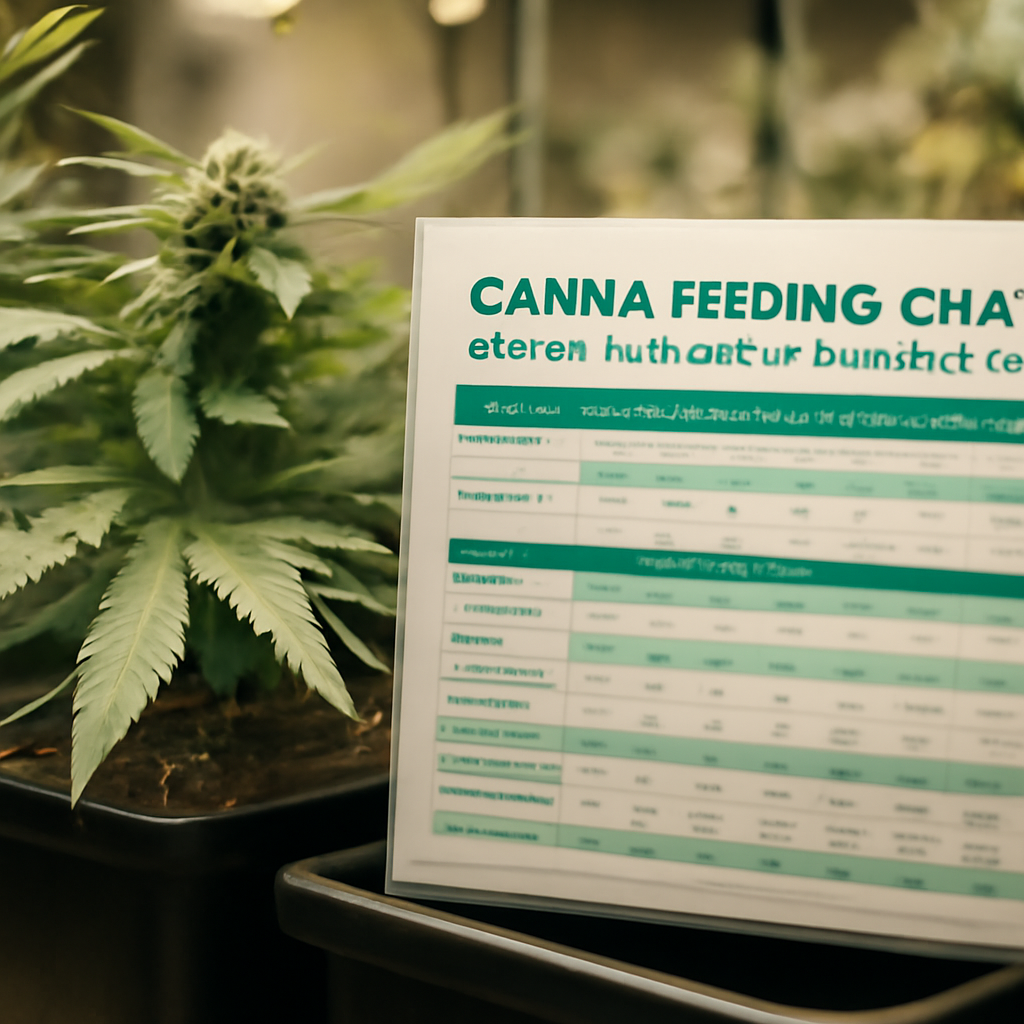
The Full Canna Aqua Feeding Chart by Week
The schedule below assumes a standard photoperiod cannabis grow: a short rooting/seedling phase, 3–4 weeks of veg, and 8 weeks of flower. Adjust week counts to match your actual strain's flowering time. All dosages are per 10 litres of water.
Vegetative Phase — Aqua Vega A+B
| Stage | Duration | Dose (per 10L) | EC Target | pH |
|---|---|---|---|---|
| Root Formation | Days 1–5 | 15–25 ml A+B | 0.7–1.1 mS/cm | 5.2–6.2 |
| Veg Week 1 | Days 6–12 | 20–30 ml A+B | 0.9–1.2 mS/cm | 5.2–6.2 |
| Veg Weeks 2–4 | Days 13–28 | 25–35 ml A+B | 1.0–1.3 mS/cm | 5.2–6.2 |
Keep veg EC conservative — cannabis roots in recirculating systems take up water faster than nutrients in warm conditions, so your EC can creep up between reservoir changes. If your EC rises more than 0.2 mS/cm overnight, top up with plain water, not fresh nutrient mix.
Flowering Phase — Aqua Flores A+B
| Stage | Week (12/12) | Dose (per 10L) | EC Target | pH |
|---|---|---|---|---|
| Transition | Weeks 1–2 | 30–35 ml A+B | 1.2–1.6 mS/cm | 5.5–6.2 |
| Flower Development | Weeks 3–4 | 35–40 ml A+B | 1.6–1.8 mS/cm | 5.5–6.2 |
| Peak Bulk | Weeks 5–6 | 35–40 ml A+B | 1.8–2.2 mS/cm | 5.5–6.2 |
| Ripening | Weeks 7–8 | 20–30 ml A+B | 1.2–1.6 mS/cm | 5.8–6.2 |
| Flush | Final 5–7 days | Plain water only | <0.4 mS/cm | 5.8–6.2 |
The drop in EC during ripening is intentional — backing off nitrogen and total salt load in the final two weeks encourages the plant to mobilise stored reserves, contributing to a cleaner dry and better terpene expression. Don't chase high EC right to the end.
Canna Aqua Additive Schedule: What to Stack and When
Stacking additives into a Canna Aqua reservoir needs to follow an order: always add base nutrients (A then B) first, let them mix fully, then add additives one at a time, checking that solution stays clear. Cloudy or precipitated solution means something reacted — dump it and start fresh.
- Rhizotonic (40 ml/10L): Root stimulator for the first 5–7 days. Contains B vitamins and plant hormones that accelerate root mass development in the hydro environment. Drop it once roots are established — it's not needed beyond that point.
- Cannazym (25 ml/10L): Enzyme complex that breaks down dead root material in your reservoir and on the roots themselves. In a recirculating system, dead root fragments are a vector for pythium — Cannazym actively reduces that risk. Use it from week 1 through final flush.
- Cannaboost (20–40 ml/10L): Bloom stimulator for the full flowering phase. Start at 20 ml/10L when you flip, ramp to 40 ml/10L during peak flower, and taper back down in the final two weeks. It adds phosphorus-available carbohydrate metabolites that support flower density.
- PK 13/14 (20 ml/10L): Phosphorus and potassium spike for one week only — typically week 6 from flip. This is a high-concentration product; do not run it for more than 7–10 days or you risk salt stress. Add it into your reservoir on the same day you do your weekly change, not into an old solution.
Canna Aqua Feeding Chart: pH and EC Monitoring Protocol
In a recirculating system, your pH and EC are not static — they drift every 24 hours based on plant uptake, temperature, and microbial activity. Here's a realistic monitoring routine:
- Daily: Check EC and pH. If EC has risen by more than 0.2 mS/cm, top off with plain pH-adjusted water. If EC has dropped by more than 0.2 mS/cm, add a diluted dose of your base nutrients to bring it back to target.
- Every 1–2 weeks: Full reservoir change. Drain completely, rinse your reservoir and lines with plain water, and mix a fresh batch. This prevents salt accumulation, removes plant exudates, and resets microbial balance.
- Solution temperature: Keep the nutrient solution at 16–22°C. Below 16°C nutrient uptake slows significantly; above 22°C dissolved oxygen drops and pythium risk spikes. Add a water chiller or aquarium heater as needed, and consider running an air stone to maintain dissolved oxygen above 6 mg/L.
pH stability is one of Aqua's genuine advantages over some other recirculating nutrients. The built-in pH buffer reduces violent swings. Still, target 5.5–6.2 for flower (the lower end of that range, around 5.5–5.8, improves phosphorus and potassium availability during peak flower), and 5.2–6.0 for veg. If you're seeing persistent pH creep past 6.5, your root zone is likely producing ammonium ions — check root health and look for early signs of root rot. The Nutrient Deficiency Identifier can help you rule out lockout issues that mimic deficiencies.
Troubleshooting Common Canna Aqua Problems
EC Creeping Up Between Reservoir Changes
Plants are drinking water faster than they're consuming nutrients — common in warm environments above 26°C canopy temp, or when VPD is low and transpiration is sluggish. Add plain water daily to dilute. If it keeps happening, increase airflow, lower room temps, and check that your VPD is in the 0.8–1.2 kPa range for veg, 1.2–1.6 kPa for flower.
EC Dropping Fast
Heavy feeders under high light intensity burn through nutrients quickly. If your EC drops more than 0.3–0.4 mS/cm per day, your plants are eating hard — bump your concentration up by 10–15% or mix nutrient topoffs rather than plain water topoffs. This is common in DWC with high PPFD (above 800 µmol/m²/s) during late veg and early flower.
Yellowing Leaves Despite Correct EC
If EC looks right but lower leaves are yellowing in flower, it's likely mobile nutrient remobilisation — normal as the plant draws nitrogen and magnesium from older tissue into flowers. It becomes a problem if the yellowing is aggressive or climbs past the lower third. Confirm pH is not drifting high (above 6.5), which locks out magnesium. A foliar spray of 0.5 g/L Epsom salt can provide emergency Mg in the short term.
Slimy Roots or Root Rot
A recirculating system with temps above 22°C and inadequate dissolved oxygen is a pythium invitation. First response: drop reservoir temp to 18°C, add hydrogen peroxide at 3 ml/L of 3% solution to shock the pathogen, increase air stone output, and check that Cannazym is in your reservoir. Do not run H₂O₂ alongside beneficial bacteria products — they're incompatible.
Harvest, Dry, and Cure After Running Canna Aqua
After a clean flush with Canna Aqua, your plants should have minimal residual salt load — which gives you a good starting position for a quality dry and cure. Harvest when 70–90% of trichomes have shifted from clear to cloudy, with 10–20% amber for a more body-forward effect.
Dry at 18–20°C with 50–60% relative humidity. Slower is better — aim for 10–14 days rather than the 5-day rush dry. Then cure in airtight glass jars, burping daily for the first week to allow CO₂ and moisture to escape. Our Dry & Cure Timer tracks both phases with alerts so you don't overburp or under-cure. After 3–4 weeks of cure, the chlorophyll-forward harshness typical of a fast dry disappears completely.
Want to project what your hydro run might yield before you're even halfway through flower? The Yield Calculator uses your light output, canopy size, and grow medium to give you a realistic harvest estimate. Pair it with your actual EC and feeding data from your grow journal for the most accurate numbers.
Integrating the Canna Aqua Feeding Chart Into Your Grow Journal
The single biggest advantage serious hydro growers have over casual ones is data. Logging EC, pH, reservoir temperature, and plant response week by week means you can spot patterns — like your plants always dropping EC faster in week 4 of flower, or pH climbing every time room temps go above 27°C. Keeping a detailed grow diary for every run lets you refine your Canna Aqua schedule for your specific setup, water source, and strains over time.
Also worth noting: your tap water EC matters. If your source water reads 0.3–0.5 mS/cm (common in hard water areas), subtract that from your target EC when mixing — you're already starting with some salt load before you add any nutrients. Always mix with the same water source, and if your base EC fluctuates seasonally, consider using reverse osmosis water for consistent results.
Frequently Asked Questions
What EC should I use with Canna Aqua in the flowering stage?
Start flowering at EC 1.2–1.6 mS/cm during transition, build to 1.8–2.2 mS/cm during peak bulking (weeks 5–6), then drop back to 1.2–1.6 mS/cm for the final ripening weeks. Always subtract your base water EC from these targets.
Can I use Canna Aqua in a DWC or recirculating system only, or is it also suitable for drain-to-waste?
Canna Aqua is specifically formulated for recirculating systems — the pH buffers and nutrient ratios are optimised for solution that gets reused. For drain-to-waste hydro or coco, Canna Hydro or Canna Coco are better matched. Running Aqua in drain-to-waste won't harm plants but you're not getting the full benefit of its formulation.
How often should I change the reservoir when using Canna Aqua?
Every 1–2 weeks is the standard recommendation. In practice, smaller reservoirs with large plant loads need weekly changes; larger reservoirs with fewer plants can go 10–14 days. Always change it if EC becomes erratic or solution colour turns dark brown.
Can I use PK 13/14 with Cannaboost in the same reservoir?
Yes — add them separately and sequentially to the water, not to each other directly. The combination is common during week 6 of flower for maximum phosphorus and potassium availability during peak bud development. Keep PK 13/14 to a single week only and don't exceed 20 ml/10L.
My pH keeps creeping above 6.5 in recirculating — what's causing it?
Root exudates and microbial activity in the reservoir raise pH over time, especially when water temps creep above 22°C. Check your Cannazym dosing, lower reservoir temp, and ensure you're doing weekly reservoir changes. Persistent high pH above 6.5 locks out phosphorus and iron, so act quickly.
References
- CANNA Research (2024). Aqua Vega product specification and application guidelines. CANNA official documentation covering two-part formulation rationale and recirculating system optimisation. other.canna.com/aqua_vega
- CANNA Research (2024). Everything about EC and pH using Aqua. Technical guidance on EC and pH management for Aqua nutrients in closed recirculating systems, including buffer mechanisms and daily monitoring protocols. other.canna.com
- Growell (2024). Canna Hydro Aqua Nutrients Feed Chart. Practical grower-facing schedule including dosing, EC targets, and reservoir temperature recommendations for recirculating hydroponic cannabis. growell.co.uk
- Bugbee, B. (2022). Nutrient management in recirculating hydroponic systems. Utah State University. Research on EC management, nutrient uptake rates, and solution temperature effects on root zone health in closed-loop growing systems. usu.edu
- Grow Guide Platform Data (2026). Internal grow journal analysis — 1,000 tracked grows. Data on indoor vs outdoor split (732 indoor), grow medium distribution, and feed type prevalence among active cannabis cultivators on the Grow Guide platform.