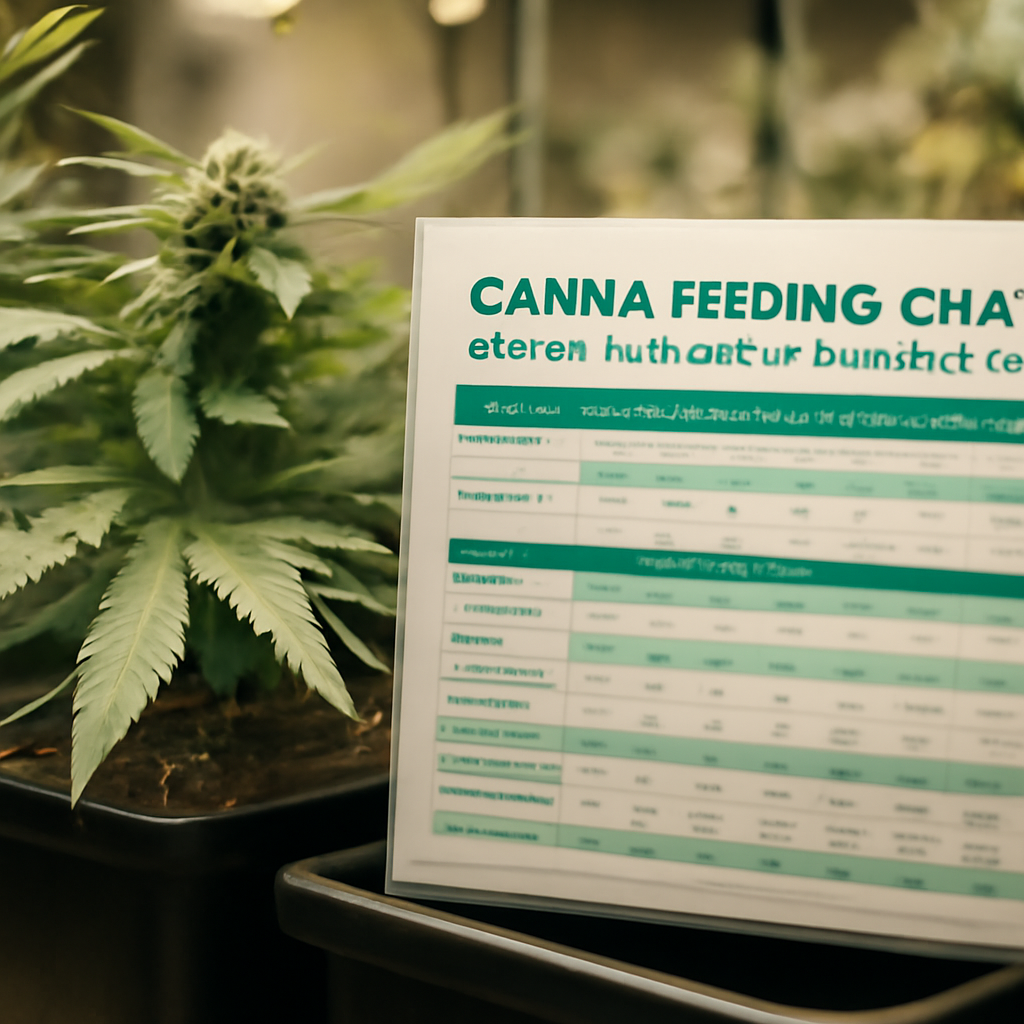
If you've got a CANNA nutrient bottle in one hand and a feeding chart in the other and you're still not sure what you're looking at — you're not alone. The CANNA feeding chart system covers four distinct substrate lines, each with its own EC targets, pH windows, and additive timing. Get the numbers right and your plants tell you immediately. Get them wrong and you're chasing lockout, tip burn, or stunted growth for weeks. Here's exactly how to read and apply the chart, medium by medium.
Why the CANNA Feeding Chart Is Substrate-Specific
CANNA doesn't publish a single universal chart because different growing media have fundamentally different cation exchange capacities, buffering abilities, and moisture retention profiles. Soil buffers pH and holds nutrients in reserve. Coco coir has a high cation exchange capacity that binds calcium and magnesium. Hydroponic systems deliver nutrients directly to the root zone with no buffer at all. Each medium demands a different approach to EC and pH — using the wrong chart for your substrate is one of the most common feeding mistakes growers make.
Of the 1,000 grow journals tracked on Grow Guide, 633 are soil grows and 148 use coco coir — making Terra and Coco the two most relevant CANNA lines for the majority of growers here. That said, hydro and recirculating setups are growing in adoption, so all four lines are covered below.
The Four CANNA Lines at a Glance
- Terra (Soil): Terra Vega (veg) + Terra Flores (flower). The most forgiving line — soil's buffering capacity means minor EC swings rarely cause immediate damage.
- Coco (Coco Coir): Coco A&B, used across both veg and flower, just at different ratios. Requires higher calcium and magnesium than soil.
- Hydro (Non-Recirculating): Hydro Vega + Hydro Flores. Drain-to-waste systems. Tighter EC management needed because there's no substrate buffer.
- Aqua (Recirculating): Aqua Vega + Aqua Flores. Reservoir-based systems. Lower working EC than Hydro because roots are constantly bathed in solution.
Canna Feeding Chart: Week-by-Week Breakdown
Below is a consolidated view of how to apply the CANNA feeding chart across a standard 12-week indoor grow (4 weeks veg, 8 weeks flower). Doses are expressed as a percentage of the chart's maximum recommended dose — start at 50–75% and ramp up only if plants are eating clean with no tip burn or lockout signs. Always start with base nutrients before adding any additives to your reservoir or watering can.
| Week | Stage | Base Nutrient | EC Target (mS/cm) | Key Additives |
|---|---|---|---|---|
| 1–2 | Early Veg | Vega / Coco A&B | 0.8–1.2 | Rhizotonic (root stim) |
| 3–4 | Late Veg | Vega / Coco A&B | 1.2–1.6 | Rhizotonic, Cannazym |
| 5–6 | Early Flower | Flores / Coco A&B | 1.4–1.8 | Cannazym, CannaBoost |
| 7–8 | Mid Flower | Flores / Coco A&B | 1.6–2.0 | CannaBoost, PK 13/14 |
| 9–10 | Late Flower | Flores / Coco A&B | 1.4–1.7 | CannaBoost only |
| 11–12 | Flush / Ripening | Plain water | 0.0–0.4 | None |
PK 13/14 timing is critical. Apply it for no more than 1–2 weeks during mid-flower (typically weeks 7–8). Using it too early stunts trichome development; using it too late adds no value. Many growers chase the PK spike and overshoot — if you see rapid leaf fade or the plant stops drinking, back off immediately.
Canna Feeding Chart for Soil (Terra Line)
The Terra line is the most beginner-friendly because soil does a lot of the pH and nutrient buffering work for you. Target EC 1.4–1.7 mS/cm at peak flower, with a solution pH of 5.8–6.2 measured before watering. The tighter the pH control in soil, the better your phosphorus and micronutrient uptake — pH drift above 6.5 locks out iron and manganese fast.
For soil, water to 10–20% runoff on every feeding and check runoff EC and pH. If runoff EC is climbing more than 0.3 mS/cm above input EC, you're building salt accumulation — flush with plain water until runoff EC drops back in range.
If you're seeing yellowing between leaf veins on newer growth, that's likely magnesium or iron lockout. Run the symptoms through our Nutrient Deficiency Identifier before adding anything to your mix.
Canna Feeding Chart for Coco (Coco Line)
Coco requires daily watering — ideally 2–4 feeds per day in late flower — because it holds air rather than nutrients in reserve. The Coco A&B formulation is designed for this: it's calcium-heavy to compensate for coco's natural cation exchange binding calcium away from roots.
Working EC for coco starts low (1.1 mS/cm in early veg) and climbs to 1.8–2.0 mS/cm at peak flower. Don't be afraid of the upper end — coco plants are heavy feeders compared to soil. pH target is 5.5–6.0 for most of the grow; dialing it to 5.8 at watering gives the broadest nutrient availability window.
One of the most common mistakes on coco: skipping the CalMag top-up when using RO or soft water. CANNA's Coco A&B already contains elevated calcium, but if your tap water is soft (EC under 0.3), add CalMag to bring baseline up before mixing nutrients.
Canna Feeding Chart for Hydro and Aqua Lines
Hydro (drain-to-waste) and Aqua (recirculating reservoir) are the precision tools of the CANNA lineup. No substrate buffer means every EC and pH swing hits roots directly. Maintain solution temperature between 16–22°C (60–72°F) — above 22°C and dissolved oxygen drops, pathogen risk climbs, and nutrient uptake becomes inconsistent.
For Hydro, pH the solution to 5.2 during vegetative growth and 5.8–6.2 during flowering. The lower veg pH improves nitrogen and phosphorus uptake when root mass is actively expanding.
For Aqua (recirculating), working EC is noticeably lower: 0.7–1.3 mS/cm in veg, rising to 1.2–2.2 mS/cm in flower. Because roots are constantly exposed to solution, the effective uptake rate is higher per unit of EC. Top up reservoir with plain water between full changes to maintain target EC — don't just keep adding nutrients.
Change reservoir solution fully every 7–10 days in recirculating systems to prevent pathogen buildup and salt stratification.
CANNA Additives: What's Worth Using and When
Rhizotonic
A kelp-derived root stimulator. Use it weeks 1–4 in veg at 4 mL/L. It increases root branching and helps transplant recovery. Drop it once roots are established and you've switched to flower — it's not needed after that and adds unnecessary cost.
Cannazym
An enzyme complex that digests dead root matter and converts it to sugars. It's low-risk and worth running from week 3 through late flower at 2.5 mL/L. Particularly valuable in coco and hydro where dead roots can harbor pythium.
CannaBoost
A carbohydrate and plant hormone booster that accelerates bud ripening. Run it at 2.5 mL/L from week 5 of flower through week 10 (stop at flush). The effect is measurable — increased terpene expression and faster trichome maturation in mid-to-late flower. Don't substitute it for proper light intensity; it's a complement, not a shortcut.
PK 13/14
13% phosphorus, 14% potassium. One of the most misused additives in cannabis. The CANNA chart places it in a single 1–2 week window in mid-flower. More is not better — excess phosphorus actively locks out zinc and iron, and excess potassium blocks calcium uptake. Stick to 1.5 mL/L for no more than 14 days.
Flushing: The Final Phase of the CANNA Feeding Chart
The final 10–14 days before harvest, switch to plain pH-adjusted water only. Target input EC of 0.0–0.4 mS/cm. This clears residual salts from root zones and substrate, resulting in a smoother, cleaner smoke. In soil, this happens naturally because of buffering; in coco and hydro, flushing is more impactful because salts accumulate faster.
Watch leaf color during flush: gradual yellowing from the bottom up is normal and healthy (the plant is mobilizing stored nutrients). Rapid overall fade or browning suggests something else is happening — stress, pH crash, or a pathogen issue.
After harvest, your dry and cure environment matters as much as your feeding chart did. Hang trimmed branches at 15–21°C (60–70°F) at 55–65% relative humidity for 7–10 days until small stems snap rather than bend. Then jar-cure for a minimum of 2–4 weeks, burping containers daily in week one. Use our Dry & Cure Timer to track the exact windows.
Dialing In Your Canna Feeding Chart: Practical Workflow
- Identify your substrate first. Terra, Coco, Hydro, or Aqua — use only the chart designed for that medium.
- Start at 50–75% of recommended dose in week one, especially for seedlings and clones. See our guide on best nutrients for cannabis seedlings for early-stage feeding specifics.
- Measure EC and pH at the source (after mixing, before watering) and again in runoff. The delta tells you what the substrate is doing.
- Log every feed. If you're not tracking input EC, output EC, and pH, you're flying blind. Our Grow Schedule Planner lets you map out the full feeding schedule week by week.
- Adjust additives one at a time. Never change your base nutrients and additives simultaneously — you won't know what caused a problem or improvement.
- Estimate final yield early so you know whether your feeding investment is tracking toward a worthwhile result. The Yield Calculator gives you a ballpark based on your setup.
For a broader look at indoor cultivation from seed to harvest, see How to Grow One Cannabis Plant Indoors. If you're running an organic approach instead of CANNA's synthetic lines, check out Best Organic Nutes for Cannabis.
Frequently Asked Questions
What EC should I target with the CANNA feeding chart for soil?
For the Terra line in soil, target 1.4–1.7 mS/cm at peak flowering with a solution pH of 5.8–6.2. Start at 0.8–1.0 mS/cm in early veg and ramp up gradually. Soil's buffering capacity gives you more tolerance for minor swings than coco or hydro.
Can I use CANNA Coco A&B in soil?
Technically yes, but it's not optimized for soil. Coco A&B is formulated with elevated calcium to compensate for coco's cation exchange — that excess calcium in soil can compete with magnesium uptake and cause imbalances over time. Use Terra Vega and Terra Flores in soil for best results.
How long should I use PK 13/14 on the CANNA feeding chart?
One to two weeks maximum, applied in mid-flower (typically weeks 7–8 of an 8-week flowering strain). Excess use leads to phosphorus toxicity and locks out zinc and iron. CANNA's own chart restricts it to a single week on most schedules — follow that guidance closely.
Do I need all the CANNA additives listed on the feeding chart?
No. Base nutrients (Vega/Flores or Coco A&B) are essential. Cannazym and Rhizotonic provide real root health benefits at low cost. CannaBoost is worth running in flower. PK 13/14 has a specific and limited role. You can run a clean, productive grow with just the base nutrients if budget is a concern.
Why is my CANNA runoff EC much higher than my input EC?
Salt accumulation in the substrate. This happens when you're feeding more than the plant is consuming, or not watering to sufficient runoff (aim for 10–20%). Flush with plain pH-adjusted water until runoff EC is within 0.2–0.3 mS/cm of your input EC, then resume feeding at a reduced dose.
References
- CANNA Research (2025). CANNA Feeding Charts — Substrate-Specific Nutrient Schedules for Terra, Coco, Hydro, and Aqua Lines. Official dosing guidelines with EC targets and pH ranges for each growing medium. canna.com
- Bugbee, B. (2021). Nutrient Management in Controlled Environments. Utah State University. Reviews the relationship between electrical conductivity, substrate buffering, and plant nutrient uptake rates in controlled cultivation systems. usu.edu
- Caplan, D., Dixon, M., & Zheng, Y. (2017). Optimal Rate of Organic Fertilizer during the Vegetative-Stage for Cannabis Production. HortScience, 52(9), 1307–1312. Establishes dose-response relationships for nutrient application rates and cannabis vegetative biomass production. doi.org/10.21273/HORTSCI11903-17
- Bernstein, N., Gorelick, J., & Koch, S. (2019). Interplay between chemistry and morphology in medical cannabis. Industrial Crops and Products, 129, 185–194. Examines how nutrient management and environmental parameters during flower development influence cannabinoid and terpene profiles. doi.org/10.1016/j.indcrop.2018.11.039
- Grow Guide Platform Data (2026). Internal grow journal analytics across 1,000 tracked grows. Data shows 633 soil-based and 148 coco-based grows, making Terra and Coco the dominant CANNA lines in active use among the platform's cultivators. growguide.app