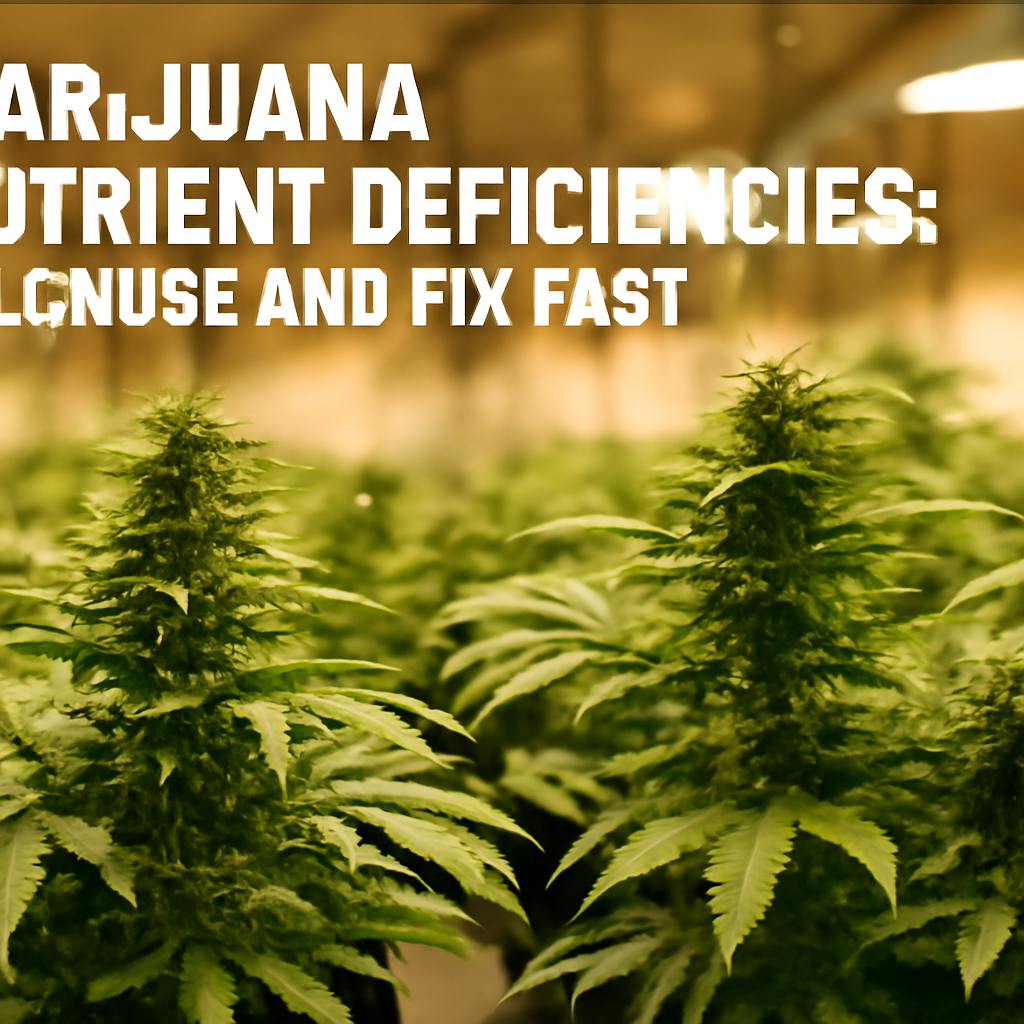
Marijuana nutrient deficiencies are one of the top reasons indoor grows underperform — and in our data from over 1,000 tracked grow journals on Grow Guide, 73.6% of growers are running indoor environments where light, pH, and feed are fully in your control. That means most deficiencies you encounter are fixable fast, without spending more money on nutrients. The problem is usually delivery, not supply. This guide walks you through every major deficiency: what it looks like, what's actually causing it, how to fix it now, and how to stop it happening again. If you want an interactive diagnosis, use our Nutrient Deficiency Identifier.
Why pH Is the Root of Most Marijuana Nutrient Deficiencies
Before you start pouring on extra nitrogen or calcium, check your pH. Nutrient lockout — where nutrients are physically present in your medium but chemically unavailable to the plant — causes symptoms that look identical to deficiency. You can be feeding correctly and still see yellow leaves if your rootzone pH is off by even 0.5 points.
- Soil: Target pH 6.0–7.0 (sweet spot: 6.3–6.8)
- Coco coir: Target pH 5.5–6.5 (sweet spot: 5.8–6.2)
- Hydroponics: Target pH 5.5–6.5 (sweet spot: 5.8–6.0)
Of the 1,000+ grow journals tracked on Grow Guide, 63.2% of growers are running soil and 15% are running coco coir — two mediums with meaningfully different pH requirements. Mixing them up is a frequent source of lockout. Calibrate your pH meter every two weeks minimum. A drifted meter is a silent killer.
The 6 Most Common Marijuana Nutrient Deficiencies
1. Nitrogen Deficiency — The Most Common Problem
What it looks like: Yellowing that starts on the oldest, lowest leaves and marches upward. The whole leaf goes uniform pale yellow, then drops. Growth slows noticeably. Unlike magnesium deficiency (which leaves veins green), nitrogen deficiency yellows the entire leaf.
What causes it: Under-feeding during veg, a pH too low (below 5.8 in soil locks out N), or a root-bound plant that can't uptake fast enough. It's also normal in weeks 6–8 of flower — the plant is cannibalizing fan leaves intentionally.
How to fix it: If it's veg or early flower: flush with pH-corrected water, then feed at 1.5–2.0 EC with a nitrogen-forward formula (N-P-K around 3-1-2). Fish hydrolysate or blood meal work fast in organic grows. You should see new growth greening up within 5–7 days. If it's late flower, leave it — it's natural senescence.
How to prevent it: Keep EC at 1.2–1.8 during veg, 1.6–2.2 during early flower. Log your feeds in a Grow Schedule Planner so you can spot drift before it shows on leaves.
2. Phosphorus Deficiency
What it looks like: Dark green or blue-green leaves with purple or reddish colouration on stems and undersides of leaves. Lower leaves develop brown or tan necrotic spots and curl downward. In flower, yields visibly suffer — buds stay small.
What causes it: Cold rootzone temps (below 60°F/15°C blocks P uptake sharply), pH above 7.0 or below 5.5, or overwatering that compresses roots. Excess zinc also antagonises phosphorus.
How to fix it: Raise rootzone temp to 65–72°F if that's the issue. Correct pH to 6.0–6.5 (soil) or 5.8–6.0 (coco). Feed with bone meal tea, bat guano, or a liquid phosphorus supplement at half strength. Don't go heavy — phosphorus toxicity causes its own problems (iron/zinc lockout).
How to prevent it: Don't let your grow space drop below 65°F at night. During transition to flower, bump P slightly — check our nutrient guide for stage-by-stage ratios.
3. Potassium Deficiency
What it looks like: Brown, scorched leaf edges starting on older leaves — looks like nutrient burn but starts at the margins, not the tips. Stems weaken, leaves curl upward, and the plant becomes more susceptible to mold and stress.
What causes it: More often lockout than actual shortage. High pH (above 7.0), excess sodium from tap water, or too much calcium/magnesium in your feed can all block potassium uptake.
How to fix it: Flush with pH-correct water (2–3x pot volume), let the medium dry down slightly, then re-feed with a balanced formula. If you're in flower, a potassium sulfate supplement at 0.5–1.0 g/L resolves it within a week.
How to prevent it: If you're on tap water, check sodium levels. High-sodium tap water (above 50 ppm Na) is a common, overlooked antagonist. Use a quality EC meter alongside your pH pen.
4. Calcium Deficiency
What it looks like: New growth is distorted — tips curl, margins look ragged or torn. Small brown spots appear on young leaves. Root tips die off in severe cases, which you'll notice as stunted growth before you see leaf symptoms.
What causes it: Extremely common in coco coir because coco naturally holds onto calcium. Also triggered by acidic conditions below pH 6.0, or by feeding heavy on potassium and magnesium (both antagonise calcium uptake).
How to fix it: In coco, always baseline with CalMag at 1–2 ml/L from day one — it's not optional. For a current deficiency: flush, pH to 6.2–6.5, then feed with a calcium supplement (calcium nitrate or a cal-mag product). New growth should be normal within 7–10 days. Damaged leaves won't recover.
How to prevent it: If you're growing in coco (15% of Grow Guide users are), treat calcium supplementation as a permanent part of your base feed, not a fix. See our organic nutrient guide for compatible organic CalMag options.
5. Magnesium Deficiency
What it looks like: Classic interveinal chlorosis — leaf tissue between the veins turns yellow while the veins themselves stay green. Starts on older, mid-canopy leaves. Rust-colored spots develop in more advanced cases. Easy to confuse with iron deficiency, but Mg deficiency starts on older leaves; iron deficiency hits new growth first.
What causes it: pH above 6.8 or below 5.8 locks out magnesium. Excessive calcium in your feed displaces it (cation antagonism). Heavy flushes without replacing Mg. RO water with no mineral baseline is another common trigger.
How to fix it: Epsom salt (magnesium sulfate) at 1 teaspoon per gallon (about 5 ml/L) as a foliar spray gives the fastest result — improvement in 3–5 days. Simultaneously water in at 0.5 tsp/gal. Correct pH to 6.0–6.5. This is one of the fastest deficiencies to reverse when pH is right.
How to prevent it: If you're using RO water, always build your baseline with a 2-part or CalMag product before adding other nutrients. Don't exceed 3:1 calcium-to-magnesium ratio in your feed.
6. Iron Deficiency
What it looks like: New growth — the youngest leaves at the top of the plant — emerges pale yellow or almost white while veins stay green. This is the key distinction: it affects new growth first, unlike nitrogen or magnesium which start at the bottom.
What causes it: High pH above 6.5 in soil (iron becomes chemically unavailable above this point), excess phosphorus (these two directly antagonise each other), or overwatering and poor drainage that creates anaerobic conditions in the rootzone.
How to fix it: Lower pH to 6.0–6.3 in soil, 5.8–6.0 in coco. Apply chelated iron (EDTA or DTPA form) — chelated iron stays available across a wider pH range than standard iron salts. Foliar application of chelated iron at 1 g per 10L water gives rapid response. Don't chase it with phosphorus — pull back on P if you've been heavy-handed.
How to prevent it: Don't let soil pH creep above 6.5. If you're using phosphorus-heavy bloom boosters, make sure your pH is dialled in tight. Our Nutrient Deficiency Identifier can help you distinguish iron vs. other new-growth issues in real time.
How to Flush and Reset a Plant With Marijuana Nutrient Deficiencies
When the deficiency is acute or you're not sure what's happening, a flush-and-reset is your safest move:
- Check pH first — if pH is correct and EC is in range, the deficiency may be biological or structural, not nutritional.
- Flush with 2–3x the pot volume of pH-corrected plain water. A 5-gallon pot gets 10–15 gallons of flush water.
- Let the medium partially dry down before re-feeding — 1–2 days for soil, 12–18 hours for coco.
- Reintroduce nutrients at 50–75% of your target EC and work back up over 3–5 days.
- Monitor runoff pH and EC at every watering for the next week.
Note: Damaged leaves won't recover. You're fixing the new growth. Don't pull old leaves unless they're fully dead — the plant is still extracting nutrients from yellowing leaves, and removing them prematurely wastes that resource.
Deficiency vs. Toxicity vs. pH Lockout — Quick Reference
| Symptom | Likely Cause | First Action |
|---|---|---|
| Uniform yellow from bottom up | Nitrogen deficiency | Check pH, re-feed N-forward formula |
| Interveinal yellow, old leaves | Magnesium deficiency | Epsom salt foliar + check pH |
| Purple/red stems, dark leaves | Phosphorus deficiency | Check rootzone temp + pH |
| Brown scorched leaf edges | Potassium deficiency or nute burn | Flush + check EC |
| Distorted, clawed new growth | Calcium deficiency | CalMag + raise pH to 6.2+ |
| White/pale new growth, veins green | Iron deficiency (lockout) | Lower pH to 6.0–6.3, chelated Fe |
| Crispy tips on all leaves | Nutrient burn (toxicity) | Flush, lower EC to 1.2–1.5 |
Preventing Marijuana Nutrient Deficiencies From the Start
Prevention is faster and cheaper than fixing. The growers who rarely deal with deficiencies share three habits:
- They log every feed — EC in, EC out, pH in, pH out, every watering. A simple grow journal catches drift before the plant shows it. Our Grow Schedule Planner makes this automatic.
- They calibrate their meters weekly — A pH pen off by 0.3 points at pH 6.0 means you're actually feeding at 5.7, right where iron, zinc, and manganese all lock out.
- They match their nutrient line to their medium — Coco-specific nutrients include baseline calcium; soil nutrients don't. Mixing the wrong formula with the wrong medium is one of the most common sources of chronic deficiency among the 1,000+ journals we track on Grow Guide.
If you're still dialling in your feed schedule, start with our seedling nutrient guide and build forward from there. Once you're consistently logging data, the Yield Calculator can show you how improved plant health translates to harvest weight.
A Note on Veganic and Organic Grows
In 2026, veganic (plant-based) nutrient formulations have become increasingly popular among craft growers, and for good reason — they're showing real improvements in terpene expression, which matters for aroma and flavor complexity. However, plant-based nutrients release more slowly than synthetics, which means deficiency symptoms can appear during transition periods or when microbial activity in the soil drops (usually from overwatering or low temps). If you're running organic, keep your soil temps above 65°F and let the medium dry down fully between waterings to keep the biology active. See our best organic nutrients guide for specific product breakdowns that prevent these gaps.
Frequently Asked Questions
How do I tell the difference between a nutrient deficiency and pH lockout?
You often can't tell by visual symptoms alone — they look identical. The fastest way is to check runoff pH. If your feed water goes in at 6.5 and comes out at 5.2, you have a lockout, not a deficiency. Fix pH first and re-evaluate after 5–7 days before adding more nutrients.
How long does it take to fix a cannabis nutrient deficiency?
With the correct fix in place, new growth should look healthy within 5–10 days. Magnesium responds fastest (3–5 days with Epsom salt foliar). Calcium takes longest — 10–14 days — because it's immobile and only new growth will show recovery. Damaged leaves never recover; you're watching for healthy new growth.
Can I foliar spray to fix nutrient deficiencies?
Yes, and for magnesium and iron in particular, foliar application is the fastest route to recovery. Spray in the lights-off period or during low-light hours to prevent leaf burn, and use filtered or RO water as your base. Don't foliar spray in flower after week 3 — moisture on buds risks botrytis.
What is the most common cannabis nutrient deficiency?
Nitrogen deficiency is the most frequently diagnosed issue, typically caused by under-feeding during the vegetative stage or pH drift that locks it out. Magnesium deficiency is a close second, particularly among coco coir and RO-water growers who don't baseline their mineral content.
Should I add more nutrients when I see a deficiency?
Not automatically. First check pH — most deficiencies are lockout issues where nutrients are present but unavailable. Adding more nutrients to a locked-out plant can push EC too high and cause toxicity on top of the deficiency. Flush, correct pH, then re-introduce nutrients at 50–75% strength.
References
- Leafly, 2026. "Nutrient Deficiencies in Cannabis: A Grower's Troubleshooting Guide." Covers pH-related lockout and symptom identification for common macro and micronutrient deficiencies. leafly.com
- Crop King Seeds, 2026. "Marijuana Deficiencies." Details symptom progression and fertilizer corrections for nitrogen, phosphorus, potassium, calcium, and magnesium in cannabis. cropkingseeds.com
- Grow Guide Platform Data, 2026. Internal analysis of 1,000+ grow journals showing environment distribution (73.6% indoor), medium usage (63.2% soil, 15% coco coir), and feeding method patterns across tracked cannabis grows.
- Budpedia, 2026. "Cannabis Cultivation in 2026: High-Tech LEDs, Veganic Nutrients and Terpene Science." Discusses the adoption of plant-based nutrient formulations and their effects on terpene profiles in legal cannabis cultivation. budpedia.com
- Pittman, J.K. & Hirschi, K.D., 2016. "Phylogenetic Analysis and Protein Structure Modelling Identifies Distinct Ca²⁺/Cation Antiporters." Foundational research on calcium transport in plants, underpinning CalMag supplementation practices in cannabis cultivation. frontiersin.org