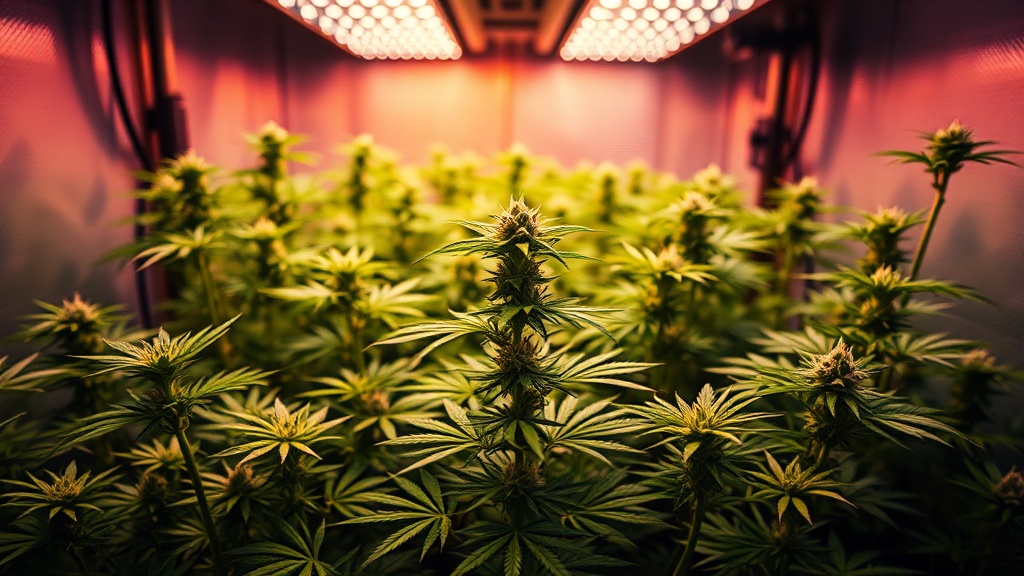
How to Grow One Cannabis Plant Indoors in 2026
Learning how to grow one cannabis plant indoors is the smartest move a first-time cultivator can make. One plant keeps your environment simple, your costs low, and your attention focused — and with the right setup, a single well-trained plant can yield 2–4 oz (56–113g) of dried flower under a quality LED. This guide walks you through every stage, from seed to sealed jar, with real numbers and zero guesswork.
What You Need Before You Start
One plant doesn't need a warehouse. A 2×2 ft (60×60 cm) grow tent is perfect. Here's the core equipment list — don't cut corners on lights or ventilation:
- Grow tent: 2×2 ft minimum, 5 ft tall or taller
- LED grow light: 100–200W quantum board (look for 2.5–3.0 µmol/J efficacy); use the Grow Light Calculator to dial in your PPFD target for the tent footprint
- Exhaust fan + carbon filter: 4-inch inline fan rated for your tent volume
- Oscillating clip fan: for stem strengthening and VPD management
- 5-gallon fabric pot (3-gallon works if space is tight)
- Growing medium: quality cannabis-specific soil (e.g., a perlite-amended mix, 20–30% perlite) or coco coir
- pH pen + EC meter: non-negotiable — pH drift kills more grows than pests
- Nutrients: a 3-part base nutrient line or an all-in-one designed for cannabis
- Hygrometer/thermometer combo
- 60–100× jeweler's loupe or digital microscope for trichome inspection
Step-by-Step: How to Grow One Cannabis Plant Indoors
Step 1 — Choose Your Strain and Germinate (Days 1–7)
Strain choice determines your timeline. Autoflowers finish in 70–90 days total and don't require a light schedule flip — ideal for beginners. Photoperiod plants give you more control over veg time and typically yield more. For a first grow, consider an autoflowering indica-dominant strain with high resistance to stress. Browse grow journals by strain in our community grows to see real results before you commit.
- Drop your seed in a glass of room-temperature, pH-adjusted water (6.0–6.5) for 12–18 hours until it sinks.
- Transfer to a damp paper towel folded inside a sealed zip-lock bag. Place in a dark spot at 75–80°F (24–27°C).
- Check every 12 hours. Tap root should appear within 24–72 hours. Plant when the tap root is 0.5–1 cm long.
- Plant 0.5 inch (1.3 cm) deep in moist (not wet) medium, tap root pointing down.
Common mistake: Overwatering at this stage. The seedling needs moisture, not saturation. Water lightly in a 2-inch radius around the stem only.
Step 2 — Seedling Stage (Days 7–21)
Your seedling doesn't need heavy light yet. Keep PPFD at 200–300 µmol/m²/s on an 18/6 schedule (18 hours light, 6 dark). Humidity should sit at 65–70% RH — seedlings uptake water primarily through their leaves at this stage.
- Temperature: 75–80°F (24–27°C) lights on, 68–72°F lights off
- VPD target: 0.4–0.8 kPa
- No nutrients until the third set of true leaves appears — your medium has enough to start
- Transplant from starter cup to final pot when roots circle the bottom (usually day 14–21)
Step 3 — Vegetative Stage (Weeks 3–8)
This is where your plant builds the structure that will hold your buds. Ramp light intensity to 400–600 µmol/m²/s. Photoperiod plants stay in veg as long as you run 18/6 light — most home growers veg for 4–6 weeks before flipping. Autoflowers handle this automatically.
Start nutrients around week 3. For soil, begin at 25–50% of the manufacturer's recommended dose and work up. Target EC of 1.0–1.6 mS/cm in runoff. Water pH should be 6.0–7.0 for soil, 5.5–6.5 for coco/hydro. Use the Grow Schedule Planner to map your feed days against your growth stage.
Training starts now. At week 3–4 of veg, top the plant above the 5th node — cut cleanly just above the node. This creates two main colas instead of one. Follow up with Low-Stress Training (LST): gently bend branches outward and secure with soft ties or LST clips, training the canopy flat. A single plant with good LST can fill a 2×2 tent canopy entirely.
Common mistake: Skipping training on a single plant. Without LST or topping, one plant in a small tent will shoot one tall, thin cola. Trained correctly, the same plant produces 6–10 colas of roughly equal size.
Step 4 — Flip to Flower (Week 8–10 from seed for photoperiods)
For photoperiod plants: switch your timer to 12 hours light / 12 hours dark. Use complete darkness — any light leaks during the dark period can cause hermaphroditism. Autoflowers don't need a flip; they trigger on their own around week 3–5.
During the first 2 weeks of flower (the "stretch"), your plant may double in height. Adjust your light height accordingly — maintain at least 12 inches between the canopy and the LED to avoid light burn, but keep PPFD in the 600–900 µmol/m²/s range.
Step 5 — Flowering Stage (Weeks 1–10 of flower)
Dial your environment tighter now. This is where quality is made or lost.
Drop RH aggressively in weeks 6–10 of flower. High humidity during late flower is the #1 cause of botrytis (bud rot) — a disaster that can destroy your entire harvest in 48 hours. Run a dehumidifier if needed to stay under 45% RH.
Nutrient profile shift: Drop nitrogen significantly at week 2 of flower and push phosphorus and potassium. A typical mid-flower EC in runoff is 1.6–2.2 mS/cm for soil. Start a flush in the final 1–2 weeks (plain pH-adjusted water only). If you spot yellowing, purple stems, or spots, use the Nutrient Deficiency Identifier before reaching for a fix — over-correcting kills more plants than the deficiency itself.
Step 6 — Harvest (Day 60–90 of flower, depending on strain)
Ignore the breeder's stated week count. Use trichomes — the only reliable harvest signal.
- Under your loupe, look at the trichomes on the bud surface (not the leaves — sugar leaves amber faster).
- Clear/translucent trichomes: Too early. THC not yet fully developed.
- Mostly cloudy/milky white: Peak THC. Cerebral, energetic high.
- 30–40% amber mixed with cloudy: THC beginning to degrade to CBN. More sedative effect, physical body high.
- Harvest when 70–80% cloudy and 10–20% amber for a balanced effect — most growers' sweet spot.
On harvest day: stop watering 24–48 hours before to reduce moisture in stems. Use sharp, sanitized scissors. Cut main branches, remove large fan leaves, then hang whole branches upside down.
Use the Yield Calculator before harvest to estimate your dry weight — it helps set expectations based on your light, canopy size, and training method.
Step 7 — Dry and Cure Your Cannabis
This stage is where most home growers lose quality. A fast, hot dry destroys terpenes and produces harsh smoke. Slow and cool wins every time.
Drying (7–14 days):
- Hang branches upside down in a dark space — light degrades THC
- Temperature: 60–65°F (15–18°C)
- Humidity: 55–62% RH
- Airflow: gentle circulation, no direct fan blast on buds
- Ready when the small stems snap cleanly rather than bend
Curing (minimum 4 weeks, up to 8+ weeks for premium results):
- Trim buds off branches. Trim fan leaves and sugar leaves to your preference (wet-trim on harvest day or dry-trim now).
- Fill wide-mouth mason jars to 70% capacity — never pack them tight.
- For the first 2 weeks, "burp" jars twice daily for 15 minutes to release CO₂ and excess moisture. If you smell ammonia, buds are too wet — leave lids off for 2 hours.
- Week 3–4: burp once every 2–3 days.
- After 4 weeks: burp weekly and seal until use.
Track your humidity inside the jars with a small digital hygrometer (Boveda 62% packs work well for maintenance). Target 58–62% RH inside sealed jars for long-term storage. Use the Dry & Cure Timer to track your burp schedule and cure progress automatically.
Quick Troubleshooting: How to Grow One Cannabis Plant Indoors Without Common Failures
| Problem | Likely Cause | Fix |
|---|---|---|
| Yellowing lower leaves (veg) | Nitrogen deficiency or pH lockout | Check runoff pH first. If in range (6.0–7.0), increase N feed by 20% |
| Leaf tips curling up | Light burn or heat stress | Raise light 2 inches, check canopy temp (should be under 84°F) |
| Spotty brown patches on leaves | Cal-Mag deficiency | Add 1–2 mL/L CalMag supplement; check pH is not below 5.8 |
| Stretching, pale internodal spacing | Light too far or intensity too low | Lower light, increase intensity, check DLI (target 35–45 mol/m²/day in veg) |
| White powder on leaves | Powdery mildew | Reduce humidity immediately below 50%, improve airflow, apply potassium bicarbonate spray |
| Ammonia smell in cure jar | Buds too wet going into jars | Leave lids off for 2–4 hours, then reseal and check daily |
Final Tips for Growing One Cannabis Plant Indoors
One plant, one tent, one grow — but keep a detailed journal. Note your watering volume, pH, EC, environment readings, and training dates. You'll catch patterns that no guide can predict for your specific setup. Every grow teaches you something the last one didn't, and your second plant will outperform your first dramatically just from what you learned watching this one.
Plan your next run before this one is done. While your buds cure, map out your next grow schedule, look up community grows for strains you want to try, and let your cured results inform every decision going forward.