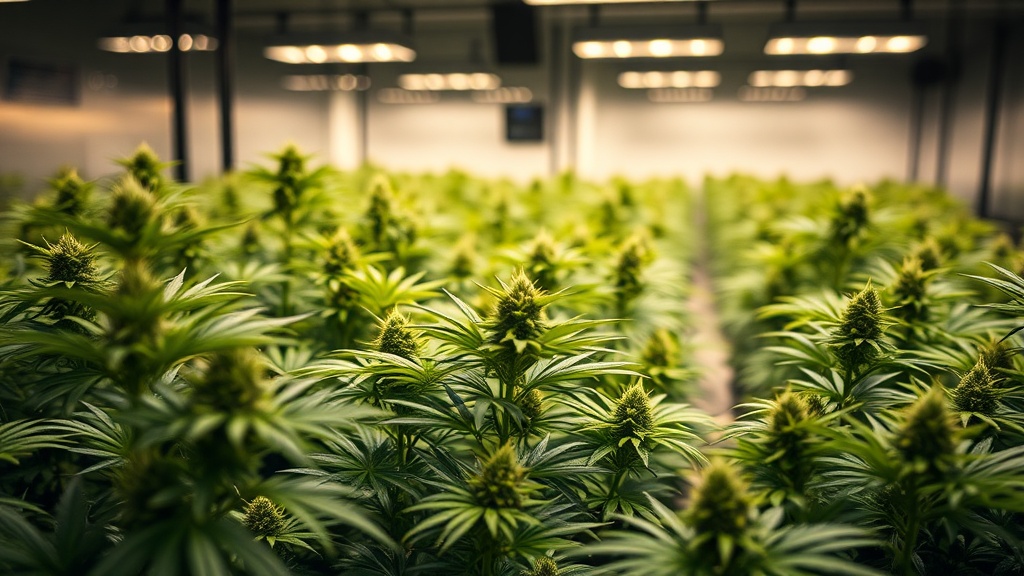
TL;DR: Growing cannabis indoors from seed to harvest takes 10–22 weeks (roughly 3–5 months), depending on strain genetics, grow method, and how long you run veg. Autoflowers finish fastest at 10–14 weeks seed-to-harvest. Photoperiod strains take 16–22 weeks but give you full control over final plant size. This guide breaks down every stage with real numbers so you know exactly what you're working with.
If you've got seeds in a paper towel right now or seedlings under your lights, the first question on your mind is: how long to grow cannabis indoors from where you're standing to a jar full of cured bud? The honest answer depends on a few decisions you make in the next week — strain type, medium, and how long you let your plants veg. Let's go stage by stage.
The Full Indoor Cannabis Timeline at a Glance
Stage 1: Germination & Seedling (Weeks 1–3)
Germination itself takes 24–72 hours using the paper towel or direct-to-medium method. Once the taproot hits 1cm, drop it into your starter cube or coco plug, root-side down. From that point, seedlings spend the next 2 weeks establishing roots before they're ready to transplant.
- Light: 18/6 schedule, keep PPFD low — 150–300 µmol/m²/s. Too much light at this stage causes bleaching and stress.
- Temperature: 72–78°F (22–26°C) with a dome to hold humidity at 65–70% RH.
- Watering: Keep the medium moist but never saturated. No nutrients yet — seedlings have all they need in the cotyledons.
- VPD: Target 0.4–0.8 kPa in this stage.
You're ready to move out of seedling stage when you see 3–4 nodes and the root system is visibly wrapping the starter plug.
Stage 2: Vegetative Stage — How Long to Grow Cannabis Indoors in Veg
This is the stage where your decisions have the biggest impact on total grow time. You can flip to flower as early as 2 weeks in veg (if you're growing autoflowers or small SOG plants) or run 8+ weeks for monster manifolds and large SCROG setups.
Standard recommendation: 4–6 weeks veg for most photoperiod strains in a 4×4 tent. That gives you a plant with enough canopy to fill the space without outgrowing your light footprint.
- Light schedule: 18/6 is the standard — 20/4 gives faster growth but runs hotter and costs more in electricity.
- PPFD: Ramp from 400 µmol/m²/s in week 1 to 600–800 µmol/m²/s by late veg.
- Nutrients: High nitrogen — target EC 1.2–2.0 in soil, 1.0–1.6 in coco/hydro. Keep pH at 6.0–7.0 in soil, 5.8–6.2 in coco or hydro.
- VPD target: 0.8–1.1 kPa. Running outside this range stresses plants and slows growth.
- Training: Topping, LST, and SCROG all happen here. Top no later than week 3 of veg to give recovery time before flip.
Use the Grow Schedule Planner to map out exactly when to top, transplant, and flip — it syncs your stage timings automatically so nothing gets missed.
Stage 3: Flowering Stage (Weeks 6–18 from Flip)
Flip to 12/12 and the clock starts. Most indica-dominant strains finish in 8–9 weeks of flower. Sativa-dominant genetics and haze varieties can run 10–12 weeks. This is the longest single stage of the grow.
What's happening week by week in flower
- Weeks 1–3 (stretch): Plants can double in height. Keep your light-to-canopy distance in check — aim for 18–24 inches with most LEDs at full power.
- Weeks 3–6 (bud development): Pistils multiply, calyxes stack, and resin glands start forming. This is when PPFD matters most — push to 800–1,000 µmol/m²/s with CO₂ supplementation at 1,200–1,500 ppm if your setup supports it.
- Weeks 6–8 (ripening): Trichomes shift from clear to cloudy/milky. Fan leaves yellow — that's normal, it's the plant pulling nitrogen from its own leaves. Back off on nutrients, reduce EC to 1.0–1.4.
- Final week (flush or no-flush): If flushing, run plain pH-balanced water for the last 7–10 days in soil. In coco and hydro, flush 3–5 days is sufficient.
When to harvest: reading trichomes
Don't go by the seed bank's stated flower time alone — genetics vary and your environment matters. Use a jeweler's loupe (30–60×) or a digital microscope to inspect trichomes on the buds themselves (not the sugar leaves, which amber faster).
- All clear: Too early. THC is still developing.
- Mostly milky/cloudy, few amber: Peak THC, more energetic effect.
- 30–40% amber: THC degrading to CBN, heavier, more sedative effect.
Autoflower vs. Photoperiod: How the Timeline Changes
Autoflowers like Northern Lights Auto or Gorilla Glue Auto are the fastest indoor option. They flower based on age, not light cycle, so you run 18–20 hours of light the whole grow. Expect 10–14 weeks seed to harvest. The trade-off is you can't extend veg to recover from mistakes, and yields are typically lower than photoperiod grows in the same space.
Photoperiod strains give you full control. If a plant gets stressed or you want to run more training, just keep it in veg longer. Strains like Wedding Cake or Blue Dream typically veg 5–6 weeks and flower 9–10 weeks for a total of around 16–18 weeks from seed.
Growing Medium & How It Affects Your Timeline
Your medium choice can shave — or add — a week or two to your overall timeline:
- Soil: Most forgiving, slowest uptake. Add 1 week to your expected timeline compared to coco. Good for beginners.
- Coco coir: Behaves like hydro but without the sterile system management. Faster growth than soil. Keep EC and pH dialed — pH 5.8–6.2, fertigation 1–3× daily in late veg and flower.
- Hydro (DWC/RDWC): Fastest growth of any medium. Plants in deep water culture with dialed EC (0.8–1.4 veg, 1.4–2.2 flower) and pH 5.5–6.0 can finish 1–2 weeks ahead of the same strain in soil.
Stage 4: Drying (Days 0–14 Post-Harvest)
How long to grow cannabis indoors doesn't end at chop — dry and cure are where you protect everything you've built. A bad dry can wreck terpene profiles in 72 hours.
- Environment: 65–72°F (18–22°C), 50–60% RH, total darkness, gentle airflow (not direct fan on buds).
- Duration: 7–14 days. A slow dry at lower humidity (55%) develops better flavor than a fast dry at 70%+ humidity.
- Check: Stems should snap, not bend. Buds should feel dry on the outside but still have slight give inside.
Track your dry room conditions with the Dry & Cure Timer — set your chop date and it tracks optimal burp windows and environmental targets through the whole post-harvest process.
Stage 5: Curing (Weeks 2–8 Post-Harvest)
Curing isn't optional — it's what separates commercially grown bud from the good stuff. The cure breaks down chlorophyll, smooths harshness, and allows terpenes to fully develop.
- Fill mason jars to 70% capacity (not packed tight).
- Burp lids for 10–15 minutes, twice daily for the first 2 weeks.
- After 2 weeks, drop to once every 2–3 days.
- Minimum cure: 2 weeks. Optimal: 4–6 weeks. Some strains (particularly haze genetics) benefit from 8+ weeks.
- Target humidity inside the jar: 58–65% RH. Use Boveda 62 packs to stabilize.
How to Speed Up Your Indoor Grow (Without Cutting Corners)
- Use autoflowers if time is your main constraint — 10–12 weeks is genuinely achievable.
- Start in coco or DWC — both medium types accelerate nutrient uptake and root growth.
- Run CO₂ supplementation — 1,200–1,500 ppm in a sealed room can accelerate development and increase yield without extending your timeline.
- Dial your VPD — plants growing outside optimal VPD (0.8–1.1 kPa in veg, 1.0–1.5 kPa in flower) grow measurably slower. This is one of the most under-managed variables in hobby grows.
- Optimize your lighting — underpowered lights extend flower time because buds don't fully bulk up. Use the Grow Light Calculator to verify your PPFD coverage before you blame genetics for a slow grow.
Environment Quick-Reference by Stage
Common Causes of a Longer-Than-Expected Grow
If your grow is running long, it's usually one of these:
- Low light intensity: Running 400 µmol/m²/s in flower when you need 800+ is the single biggest timeline extender. Buds simply don't bulk up properly. Check your coverage with the Grow Light Calculator.
- Nutrient deficiencies: A calcium or magnesium deficiency mid-flower stalls bud development. Use the Nutrient Deficiency Identifier if you see unexplained leaf symptoms.
- pH drift: If your root zone pH creeps above 7.0 in soil or above 6.5 in coco, you'll get nutrient lockout that mimics deficiency and slows the grow down.
- Temperature stress: Consistently above 85°F (29°C) in the canopy during flower inhibits terpene production and can hermaphrodite stress-sensitive strains.
- Wrong harvest timing: Waiting for amber trichomes that never come on some sativa strains — they can finish with mostly milky trichomes and it's correct.
Plan Your Grow Before You Start
The most effective thing you can do before dropping seeds is build a week-by-week schedule. Knowing your flip date, expected harvest window, and post-harvest timeline before you start means you're making decisions proactively, not reactively. The Grow Schedule Planner builds this automatically around your strain type and medium — worth setting up on day one.
If you want to estimate yield before you commit to a setup, the Yield Calculator factors in your light, space, and strain type to give a realistic range before you've spent anything.
Bottom line: Indoor cannabis takes 10–22 weeks from seed to cured bud. Autoflowers get you there in 10–14 weeks. Photoperiod strains in the 16–20 week range give you better yield and quality control. Every week you invest in dialing environment, light, and nutrients pays back in faster development and heavier, better-quality harvests.