What Is Gorilla Gas?
Gorilla Gas is a hybrid cannabis strain that earns its name — it grows with the aggression of a Gorilla Glue lineage and produces a fuel-forward terpene profile that hits the nose the moment you crack a jar. THC content consistently tests in the high 20s to low 30s depending on phenotype and grow conditions, making it a strain that rewards growers who put in the work on environment and technique. If you've got a tent dialed and want something that pushes resin production hard, Gorilla Gas belongs on your next run list. You can track your entire grow from seed to cure in a Grow Schedule Planner to keep every milestone on target.
Based on data from over 1,000 grow journals tracked on Grow Guide, 73.7% of growers run indoor environments — exactly the setup where Gorilla Gas performs best. The strain's density and resin output are maximized when you control every variable, and that's what this guide is built around.
Gorilla Gas Genetics and Growth Structure
Gorilla Gas typically crosses Gorilla Glue #4 genetics with a fuel-leaning hybrid, producing plants that grow medium-tall with wide internodal spacing and lateral branch structure that responds extremely well to training. Expect vigorous vegetative growth — this isn't a strain you leave to do its own thing. Left unchecked, it stretches hard in early flower and can outgrow a standard 1.8m tent in a 12-week run.
The structure is naturally Christmas-tree shaped, which means without training, the lower canopy gets shaded and bud sites there remain airy and underdeveloped. Fix that with LST or SCROG early and you'll see the difference at harvest. You can browse other growers' documented Gorilla Gas grows on the platform for phenotype comparisons before you commit.
Gorilla Gas Grow Timeline
Knowing your milestones before you drop seed saves you from scrambling mid-run. Here's the full timeline for a typical indoor photoperiod Gorilla Gas grow. For how overall indoor timelines break down, see our deep dive on how long to grow cannabis indoors.
Vegetative Stage: Building the Frame for Gorilla Gas Yields
Run 18/6 lighting during veg. Gorilla Gas responds aggressively to high nitrogen inputs at this stage — push your EC to 1.4–1.8 mS/cm in a coco or soil medium and you'll see internode stacking and dark green, waxy leaves that indicate the plant is genuinely healthy. Keep pH at 6.0–6.5 in soil and 5.8–6.2 in coco.
PPFD during veg sits at 400–600 µmol/m²/s. Run your grow light calculator to confirm you're hitting that at canopy level — our Grow Light Calculator will tell you exactly where to hang your fixture to avoid bleaching the tops while still pushing lowers.
Start LST as soon as the fourth node appears — Gorilla Gas's lateral branching is where it builds yield, so the earlier you begin bending the main stem and pegging it down, the more even your canopy will be when you flip. If you prefer a screen, get the net in place by week 3 and start weaving shoots through as they hit the mesh. Aim for 60–70% screen coverage before you flip to 12/12. For the full breakdown on these techniques, check out our fimming vs. topping guide.
Flowering Stage: Gorilla Gas Environment and Nutrition
Flip to 12/12 when your screen is at 60–70% fill or after 4–6 weeks of veg, whichever comes first. Gorilla Gas will stretch another 50–75% in weeks 1–3 of flower — account for this before you flip or you'll be fighting the ceiling.
Lighting and PPFD for Gorilla Gas in Flower
Ramp PPFD to 700–900 µmol/m²/s through weeks 1–5, then push to 1,000 µmol/m²/s in weeks 6–8 if your CO₂ levels and VPD are dialed. Without CO₂ supplementation, don't push above 900 — you'll see light stress before you see yield gains. CO₂ at 1,000–1,200 ppm unlocks the top end of the PPFD range and makes a real difference on Gorilla Gas's resin coverage.
Temperature and VPD
Daytime temperatures of 68–77°F (20–25°C) with lights on. Drop night temps 5–10°F in late flower to trigger anthocyanin expression if your pheno carries those genetics — some Gorilla Gas cuts show light purple hues in the final two weeks when night temps hit 60–63°F. VPD should sit between 1.0–1.5 kPa in flower. During late flower (weeks 7–9), push toward the upper end of that range at 1.2–1.5 kPa to stress-trigger additional trichome production without actually stressing the plant.
Relative Humidity in Flower
Pull RH down to 40–50% once you hit week 3 of flower. Gorilla Gas builds dense, compact buds that trap moisture — if you're sitting at 55%+ in weeks 5–9, you're inviting botrytis. It's not dramatic until it is. Drop to 35–40% in the final two weeks for a natural "pre-dry" on the plant. Run a dehumidifier on a controller, not a timer, for accuracy.
Gorilla Gas Nutrient Schedule
Transition from high-N to a bloom formula at flip. A good working framework for Gorilla Gas in flower:
- Weeks 1–3 (early flower): EC 1.8–2.2 mS/cm, N:P:K ratio favoring P and K. Reduce nitrogen to roughly 30% of your total nutrient profile. Keep calcium and magnesium topped up — 150–200 ppm Ca, 50–70 ppm Mg.
- Weeks 4–6 (mid flower/bulk): EC 2.0–2.4 mS/cm. Push phosphorus. This is when Gorilla Gas is stacking calyxes — don't starve it. Add a PK booster at manufacturer rates.
- Weeks 7–8 (late flower/ripening): Drop EC to 1.4–1.8 mS/cm. Cut nitrogen almost entirely. Gorilla Gas will cannibalise lower fan leaves — this is normal at this stage, not a deficiency.
- Final 7–14 days (flush): Plain pH-corrected water only. This strips excess salts from the medium and improves the smoothness of the smoke significantly.
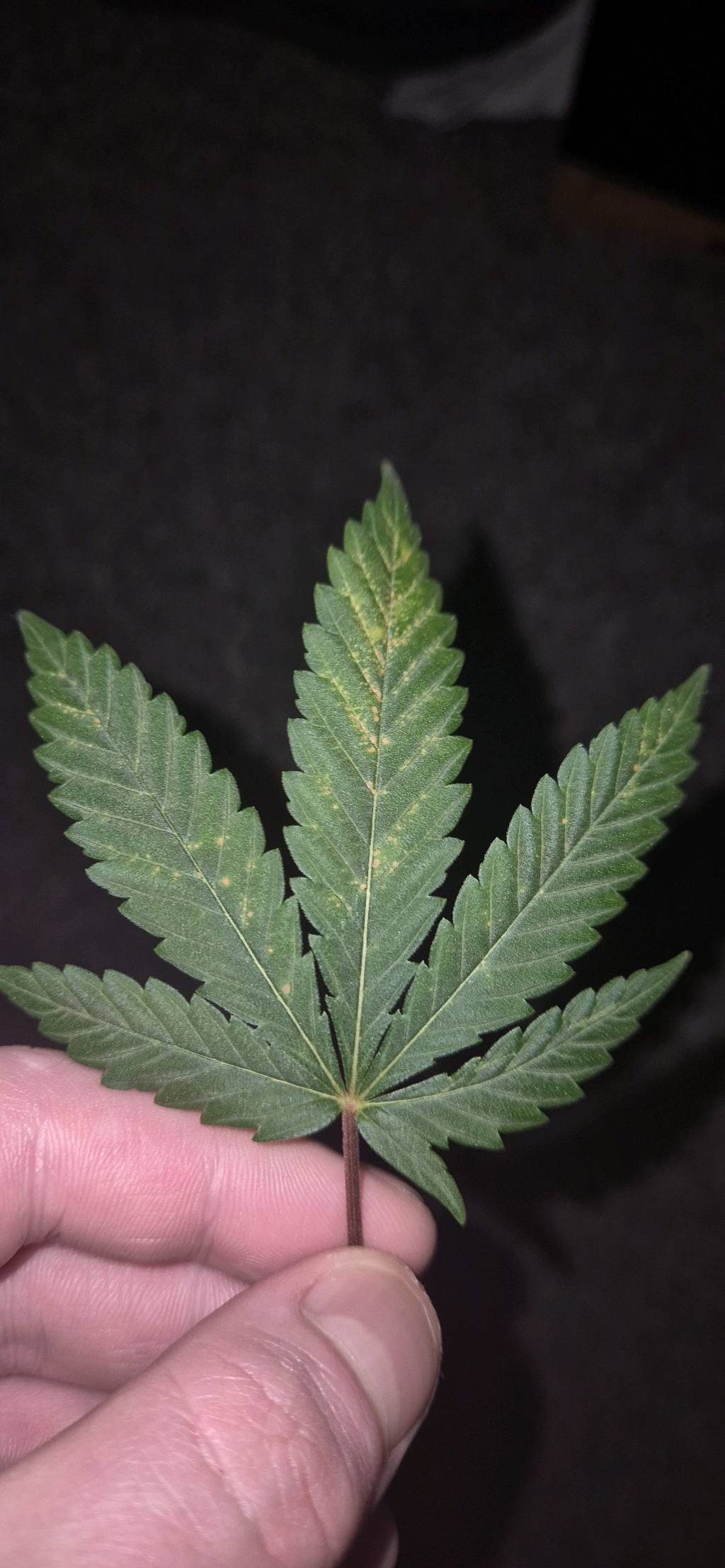
If leaves start showing unexpected discolouration mid-cycle, run your symptoms through the Nutrient Deficiency Identifier before adjusting — misdiagnosing a pH lockout as a deficiency and dumping more nutrients in will make it worse. Also reference our article on best organic nutrients for cannabis if you want to take a living soil approach with this strain.
Harvest Timing for Gorilla Gas
Gorilla Gas finishes in approximately 8–9 weeks of flower from flip. Don't rely on the calendar alone — trichome inspection is non-negotiable on a strain this potent because the THC-to-CBN conversion window affects your high type dramatically.
- All clear trichomes: Too early. THC is still building. Wait.
- 70–80% milky, 20–30% amber: Peak THC window. Harvest here for the most cerebral and potent effect profile that Gorilla Gas is known for.
- 50%+ amber: THC is degrading to CBN. More sedative, less potent. Some growers targeting specific effects go here, but it's not the sweet spot for this strain.
Use a jeweller's loupe at 60–100x or a digital microscope. Check trichomes on the bud itself, not the sugar leaves — leaves mature faster and will read amber earlier than the actual calyx trichomes. Flush for 7–14 days before harvest in a soil grow; 5–7 days in coco is usually enough given the medium's lower buffering capacity.
Once you're ready to chop, estimate your final numbers using the Yield Calculator to see how your training method and canopy size translate to expected grams.
Drying Gorilla Gas: Don't Rush It
Gorilla Gas's dense buds make a slow dry essential. A fast dry at high temps will lock chlorophyll into the bud, giving you a harsh, green-tasting smoke that wastes the terpene profile you spent months building.
Target conditions: 60–65°F (15–18°C), 50–60% RH, complete darkness, gentle air circulation (no fans blowing directly on buds). Hang whole branches upside down. At these parameters, drying takes 10–14 days — that's intentional. Buds are ready to jar when the outer surface feels dry but the inner stem snaps rather than bends. If stems are still bending, keep drying.
A common mistake with Gorilla Gas specifically: the buds look and feel dry on the outside within 5–6 days at normal room conditions, but the interior moisture is still migrating outward. Jar too early and you'll get anaerobic conditions, mould, and hay smell. Use our Dry & Cure Timer to track your dry phase and get reminders for burping sessions.
Curing Gorilla Gas for Full Terp Expression
This is where the fuel and pine terpenes that define Gorilla Gas really develop. A minimum 4-week cure is the baseline; 6–8 weeks will noticeably improve flavour complexity and smoothness.
Cure protocol for Gorilla Gas:
- Trim dried buds and pack loosely into wide-mouth glass mason jars, filling to about 75% capacity.
- Store in a cool, dark location: 60–70°F (15–21°C), target 62% RH inside the jar (Boveda 62 packs work well as a reference, not a substitute for proper moisture management).
- Burp daily for 15–30 minutes in week 1. If you open a jar and smell ammonia, the buds went in too wet — leave them open for 2–3 hours, then re-jar and burp twice daily.
- Taper to every other day in week 3, then 2–3 times per week through week 4.
- Weeks 5–8+: weekly checks. The fuel and diesel terpenes in Gorilla Gas develop noticeably between week 4 and week 6 — it's worth the patience.
For a full cure-tracking workflow tied to specific days and reminders, use the Dry & Cure Timer.
Pest and Mould Prevention on Gorilla Gas
Dense bud structure = higher botrytis (grey mould) risk, full stop. Your first line of defence is the environment: keep RH below 50% in flower, maintain good air circulation through and under the canopy, and defoliate aggressively at weeks 3 and 6 of flower to open up bud sites. Remove any leaves that are trapped between colas — they hold moisture and are the first place mould takes hold.
For spider mites, a preventive application of neem oil or insecticidal soap every 10–14 days in veg is effective. Stop all foliar sprays by week 3 of flower — late-stage foliar application on dense Gorilla Gas buds traps moisture and creates exactly the conditions you're trying to avoid. Inspect the underside of leaves during every training session; catching spider mites in veg costs you an afternoon; catching them in week 7 of flower costs you a harvest.
Keeping a Gorilla Gas Grow Journal
Tracking your Gorilla Gas run from day one pays dividends on the next one. Record your daily temps, VPD, EC at feed and runoff, pH, and training notes. When you see a phenotype that hits harder or yields better, your journal tells you exactly what you did differently. See how to build a consistent tracking habit in our guide to keeping a cannabis grow diary, or go deeper with the complete grow diary guide.
Frequently Asked Questions
How long does Gorilla Gas take to flower?
Gorilla Gas typically finishes in 8–9 weeks of flower from the 12/12 flip. Always confirm with trichome inspection rather than relying solely on day counts — look for 70–80% milky trichomes with 20–30% amber for peak potency.
What PPFD does Gorilla Gas need in flower?
Target 700–900 µmol/m²/s through weeks 1–5 of flower, then push to 1,000 µmol/m²/s in weeks 6–8 if you're running CO₂ at 1,000–1,200 ppm. Without CO₂, keep the ceiling at 900 µmol/m²/s to avoid light stress.
Is Gorilla Gas difficult to grow for beginners?
It's intermediate-level. The vigorous growth is easy to manage, but the dense bud structure demands strict humidity control (40–50% RH in flower) and aggressive defoliation to prevent botrytis. Beginners who dial in their environment first will do fine.
What humidity should I cure Gorilla Gas at?
Target 58–62% RH inside sealed jars throughout the cure. Below 55% and terpenes degrade and buds become harsh; above 65% and you risk mould developing in the jar. A digital hygrometer inside the jar gives you accurate readings.
What training method works best for Gorilla Gas?
SCROG is the highest-yielding approach for Gorilla Gas indoors because it controls the stretch and maximises the canopy's exposure to direct light across all bud sites. LST is a solid choice for smaller spaces or single-plant grows where a screen isn't practical.
References
- Gorilla Grow Tent (2026). How to Grow a Cannabis Plant: Training, Pruning and Defoliation Techniques. Covers LST, SCROG, topping and FIMing for maximising bud sites and canopy evenness. gorillagrowtent.com
- Blimburn Seeds (2026). How to Grow Gorilla Fire Strain: Drying and Curing Protocol. Documents optimal drying parameters (60–70°F, 50–60% RH, 7–14 days) and cure conditions (58–62% RH, 2–4 weeks minimum) for Gorilla-lineage strains. blimburnseeds.com
- DNA Genetics (2026). GG4 Odour Management and Ventilation Guide. Covers inline fan sizing, carbon filter selection, and air exchange rates for controlling odour and preventing mould on dense Gorilla Glue phenotypes. dnagenetics.com
- Joint Commerce / Pacific NW Roots (2026). Gorilla Gas Strain: Comprehensive Cultivation Guide. Documents recommended PPFD ranges (400–600 µmol/m²/s veg, 700–1,000 µmol/m²/s flower) and environmental parameters for Gorilla Gas specifically. app.jointcommerce.com
- Grow Guide Platform Data (2026). Internal grow journal analytics across 1,000 tracked grows. Environmental breakdown: 73.7% indoor, 17% outdoor, 3.2% greenhouse. Medium breakdown: 63.3% soil, 15% coco coir.