What Is the Cap Junky Strain?
The Cap Junky strain is the result of a collaboration between two of the most respected names in modern cannabis genetics: Seed Junky Genetics and Capulator. The cross — Alien Cookies × Kush Mints #11 — produces a hybrid that combines the dense, resinous structure of Kush with the complex terpene profile of Alien Cookies. The result is one of the most potent indoor strains available, regularly testing between 30–35% THC, with select phenotypes reaching 40% under optimized conditions.
On the Grow Guide platform, Cap Junky is tracked predominantly by indoor growers — consistent with the strain's preference for a controlled environment where you can dial in VPD, PPFD, and EC precisely. Of the 1,000 tracked grows across our platform, 736 are indoor builds, and Cap Junky growers fit squarely into that cohort.
This guide covers everything from the first training cut in veg through the final burp of the cure jar — with specific numbers at every stage.
---Cap Junky Strain Genetics and What They Mean for Your Grow
Understanding the parentage tells you what to expect on the plant. Alien Cookies brings an open, branchy structure and high terpene expression — particularly limonene and caryophyllene. Kush Mints #11 adds lateral density, a compact internode stack, and that characteristic elevated calcium and magnesium demand. When the two combine in Cap Junky, you get a plant that wants to bush out fast in veg, stretches aggressively in early flower (1.5–2× its vegetative height), and then stacks calyxes in a way that looks almost unreal by week 7.
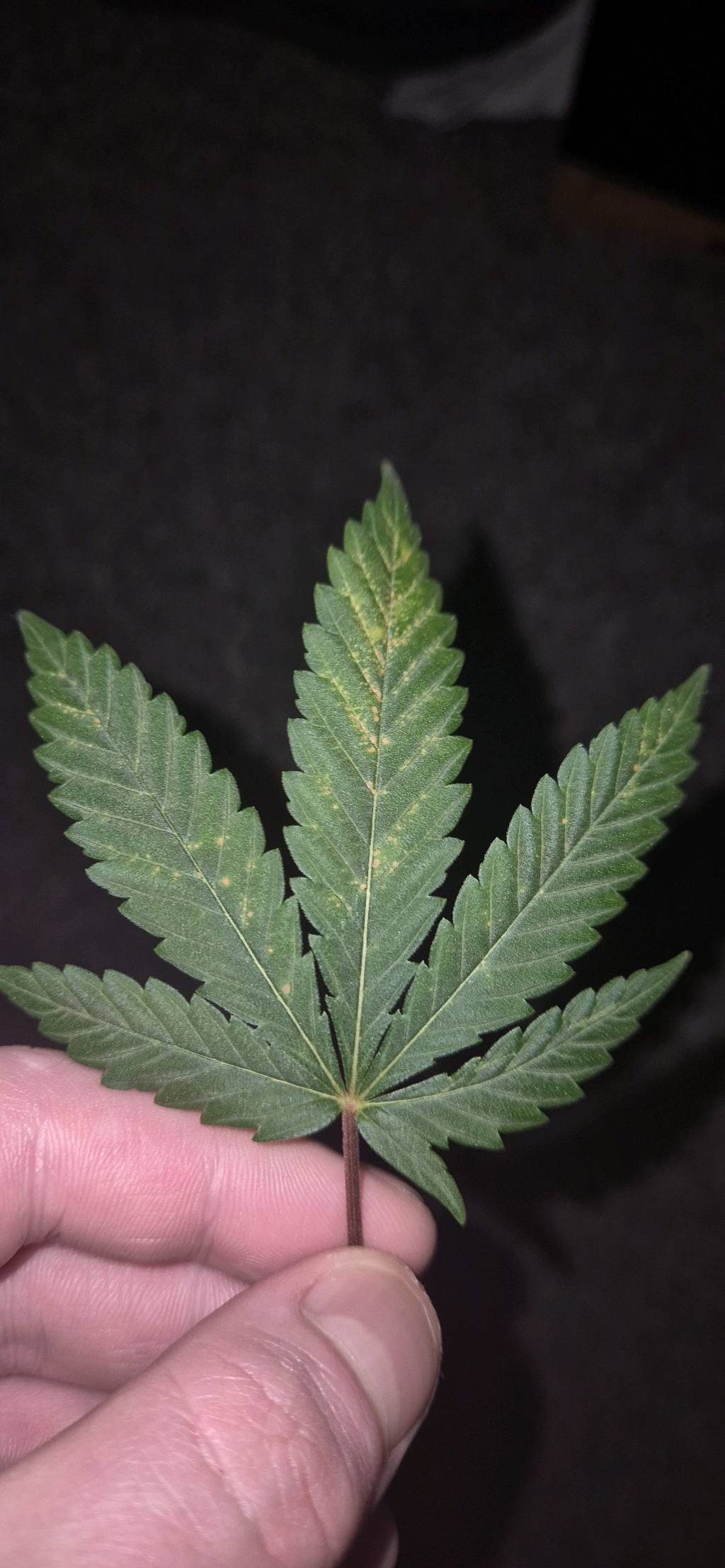
The Kush Mints side is the one that will bite you if your Ca/Mg is off. Watch for interveinal chlorosis and tip curl in weeks 3–5 of flower — that's your first sign. Use the Nutrient Deficiency Identifier to confirm before adjusting your feed.
---Vegetative Stage: Training the Cap Junky Strain for Maximum Structure
Cap Junky moves fast in veg. A standard vegetative period runs 21–35 days indoors depending on your final canopy target. For a 4-plant SCROG in a 4×4, 28 days from transplant is a reliable target. For a single-plant maximizer approach, push to 35 days and run two trellis layers.
Topping and LST Schedule
- First top: Node 5 or 6, typically around day 14–18 from transplant. The plant recovers fast — you'll see lateral explosion within 4–5 days.
- LST: Begin immediately after the first top. Tie down the two main branches at 45° and let laterals grow vertically.
- Second top (optional): If running a SCROG, top the two main branches again at node 3 of each — this gives you 4 even mains to weave into the net.
- Defoliation: Light defoliation at transition — remove fan leaves blocking bud sites, not structural leaves. Cap Junky needs those leaves for the stretch.
For a full topping vs. FIM decision tree, see our Fimming vs Topping Cannabis guide. For Cap Junky specifically, topping wins — the FIM response can be uneven given the genetic variability across phenotypes.
Vegetative Environmental Targets
- Temperature (lights on): 75–82°F (24–28°C)
- Temperature (lights off): 68–72°F (20–22°C)
- RH: 65–75%
- VPD: 0.8–1.1 kPa
- PPFD: 400–600 µmol/m²/s at canopy
Flowering Stage: Week-by-Week for the Cap Junky Strain
Cap Junky's flowering period is 8–10 weeks, with most phenos finishing at week 9. The stretch in weeks 1–3 is significant — plan for 1.5–2× your end-of-veg height. A plant that's 50cm at flip will likely finish at 90–100cm. If you're running a tent with limited vertical space, top early and keep veg height under 45cm before the flip.
Weeks 1–3: Stretch and Structure
- Temperature: 75–81°F (24–27°C)
- RH: 55–65%
- VPD: 1.0–1.2 kPa
- EC (coco/hydro): 1.6–1.8
- PPFD: 600–800 µmol/m²/s
- pH (soil): 6.3–6.8 | pH (coco/hydro): 5.7–6.1
This is when you tuck fan leaves aggressively and do your last major defoliation at day 21 of flower. Don't strip — tuck first, remove only what genuinely blocks a bud site.
Weeks 4–6: Peak Nutrient Demand
- Temperature: 73–79°F (23–26°C)
- RH: 50–55%
- VPD: 1.1–1.3 kPa
- EC (coco/hydro): 1.9–2.2
- PPFD: 900–1,100 µmol/m²/s (under elevated CO₂)
This is Cap Junky's heaviest feeding window. If you're seeing clawing, check runoff EC before reducing feed — the Kush Mints genetics are genuinely hungry, and backing off too early costs you density. The Grow Schedule Planner is useful here for mapping when to ramp EC and when to taper.
Weeks 7–9+: Ripening and Resin Finish
- Temperature: 72–77°F (22–25°C)
- RH: 45–50%
- VPD: 1.2–1.4 kPa
- EC (coco/hydro): Taper to 1.4–1.6 in the final 10–14 days
- PPFD: 800–1,000 µmol/m²/s
Drop temperature differential between lights-on and lights-off to 8–10°F in this window to encourage anthocyanin expression and terpene stacking. Use the Grow Light Calculator to confirm your DLI is hitting 40–50 mol/m²/day at this stage.
Nutrients for the Cap Junky Strain
The Kush Mints #11 lineage creates a measurably higher Ca/Mg demand than most hybrids. In coco, run CaMg at 200–250ppm (as calcium) through weeks 2–6 of flower. In soil, this is less acute — the buffer capacity of a quality amended soil handles most of it — but still supplement at 2–3ml/L of a dedicated CaMg product if you see the early signs.
EC Feed Schedule (Coco / Hydro)
| Stage | EC Target | pH Target |
|---|---|---|
| Early veg | 1.2–1.4 | 5.8–6.0 |
| Late veg / transition | 1.5–1.7 | 5.8–6.0 |
| Early flower (wk 1–3) | 1.6–1.8 | 5.8–6.1 |
| Peak flower (wk 4–6) | 1.9–2.2 | 5.9–6.1 |
| Late flower (wk 7–8) | 1.6–1.9 | 5.8–6.0 |
| Final 10–14 days | 1.4–1.6 | 5.8–6.0 |
For soil growers, maintain pH at 6.3–6.8 throughout. For a deep dive on seedling-stage nutrition before you get to this point, check the Best Nutrients for Cannabis Seedlings guide.
---Medium Selection for the Cap Junky Strain
Cap Junky performs well in both soil and coco coir. On our platform, 634 out of 1,000 tracked grows use soil as their primary medium — and for Cap Junky, a well-amended living soil with perlite at 25–30% is an excellent choice if you want to reduce feed frequency and let the genetics express terpene complexity. Coco coir (tracked in 149 of our grows) gives you more dial-in precision for EC and Ca/Mg, which is exactly what this strain's Kush Mints side wants. If you're chasing the 35%+ THC ceiling, coco with precise fertigation gives you the edge.
---Harvest Timing: Reading Cap Junky Trichomes
Don't rely on the calendar alone. Cap Junky is a 9-week strain on average, but individual phenos can run to 10 weeks. Use a jeweler's loupe (30–60×) or a digital microscope to read trichomes directly. Your harvest window:
- Early harvest (more cerebral): 80–90% cloudy trichomes, minimal amber
- Peak harvest (balanced): 90–95% cloudy, 5–10% amber on the calyxes (not the sugar leaves)
- Late harvest (heavier, more sedative): 15–20% amber — not recommended for Cap Junky; the flavor profile degrades past this point
Check trichomes on the main cola buds, not the sugar leaves — leaves mature faster and give a misleading early reading.
---Drying and Curing the Cap Junky Strain
Cap Junky's dense bud structure and high resin content make proper drying non-negotiable. Rush the dry and you lose the terpene complexity that makes this strain worth growing. Here's the protocol:
Drying
- Hang whole plants or large branches in a dark room
- Temperature: 60–65°F (15–18°C)
- RH: 55–60%
- Airflow: gentle indirect fan — no direct airflow on the buds
- Duration: 7–10 days until small stems snap cleanly
Curing
- Fill airtight glass jars to 75% capacity
- Storage temperature: 60–65°F (15–18°C)
- Target RH inside jar: 58–62% (use Boveda 62s)
- Burp daily for the first 7 days (open lids for 10–15 minutes)
- Reduce to every 2–3 days for weeks 2–4
- Minimum cure: 3–4 weeks. Cap Junky really opens up at 6–8 weeks — the terpene profile shifts from sharp to creamy and complex
Use the Dry & Cure Timer to track your drying and curing stages with reminders for burping and humidity checks.
Yield Expectations and ROI
Indoor yields for Cap Junky run 400–550g/m² when conditions are dialed in — the higher end requires CO₂ supplementation at 1,200–1,500ppm during peak flower, combined with 900–1,100 PPFD and the tight VPD range from the week 4–6 targets above. Without CO₂, expect the lower end of the range, which is still exceptional for a 30%+ THC strain.
To model your expected output before harvest, use the Yield Calculator and plug in your light footprint, plant count, and grow method. For post-harvest cost analysis, the Cost Per Gram Calculator helps you benchmark whether your input costs make sense for the output you're hitting.
Want to track your Cap Junky run properly from day one? Our guide to keeping a cannabis grow diary covers the data points worth logging every day — and a detailed journal is the fastest way to dial in a complex strain like this across multiple runs.
---Frequently Asked Questions
How long does the Cap Junky strain take to flower?
Cap Junky's flowering period is 8–10 weeks, with most phenotypes finishing at 9 weeks. Check trichomes starting at week 8 — look for 90–95% cloudy trichomes with 5–10% amber on the calyxes for peak potency and flavor.
What THC percentage does Cap Junky test at?
Cap Junky regularly tests between 30–35% THC, with some phenotypes reaching up to 40% under optimal conditions including elevated CO₂, precise VPD management, and a slow 6–8 week cure.
Is Cap Junky hard to grow for beginners?
Cap Junky is intermediate-to-advanced difficulty. Its aggressive stretch (1.5–2× in flower), elevated Ca/Mg demand, and sensitivity to humidity in late flower require growers to be comfortable with VPD management, EC monitoring, and SCROG training. It's not the best first strain, but the single plant indoor grow guide covers the fundamentals you'll need.
What medium is best for growing Cap Junky?
Coco coir gives you the most precision for managing Cap Junky's Ca/Mg demand and EC ramp schedule, which is the path to peak yields. Well-amended soil with 25–30% perlite is a solid alternative that requires less frequent feeding and tends to produce a fuller terpene profile.
Why does Cap Junky show calcium deficiency in flower?
The Kush Mints #11 lineage in Cap Junky creates a higher-than-average calcium and magnesium demand, especially in weeks 3–5 of flower. In coco or hydro, run calcium at 200–250ppm and supplement with a dedicated CaMg product. Confirm with the Nutrient Deficiency Identifier before adjusting — interveinal chlorosis can also indicate iron or sulfur issues at similar VPD ranges.
References
- Cannabis Training University (2026). Cap Junky Strain Profile — documents THC range of 30–35%, parentage (Alien Cookies × Kush Mints #11), and cultivation characteristics. cannabistraininguniversity.com
- Joint Commerce Cannabis Blog (2026). Cap Junky Weed Strain: A Comprehensive Strain Guide — details VPD targets, EC schedules, PPFD requirements, and SCROG training recommendations for Cap Junky. app.jointcommerce.com
- MMJ.com (2026). Drying and Curing Cannabis: A Complete Guide — covers optimal drying temperature (60–70°F), humidity (55–60%), and curing jar protocols including burping schedule and humidity targets. mmj.com
- The Seed Connect Blog (2026). Organic Cannabis Cultivation: Feminized Techniques — discusses trichome-based harvest timing methodology including cloudy/amber ratios for peak potency assessment. theseedconnect.com
- Grow Guide Platform Data (2026). Internal grow journal statistics across 1,000 tracked grows — environmental and medium breakdown showing 736 indoor grows (73.6%), 634 soil-medium grows (63.4%), and 149 coco coir grows (14.9%). growguide.app