Why a Cannabis Growth Chart Actually Matters
Most grows go sideways not because of bad genetics or cheap lights — they go sideways because the grower is treating a plant in week 6 of flower the same way they treated it in week 2 of veg. A cannabis growth chart solves that. It gives you a concrete reference for what your plant needs right now: how much light, how much water, what EC, what VPD, and what to watch for.
Of the 1,000 grow journals tracked on Grow Guide, 73.2% are indoor grows — and indoor growers live or die by environmental precision. This guide gives you the numbers, the stage boundaries, and the actions to take at each one. Use the Grow Schedule Planner to generate a personalized version of this chart for your specific strain and setup.
The Cannabis Growth Chart: All 6 Stages at a Glance
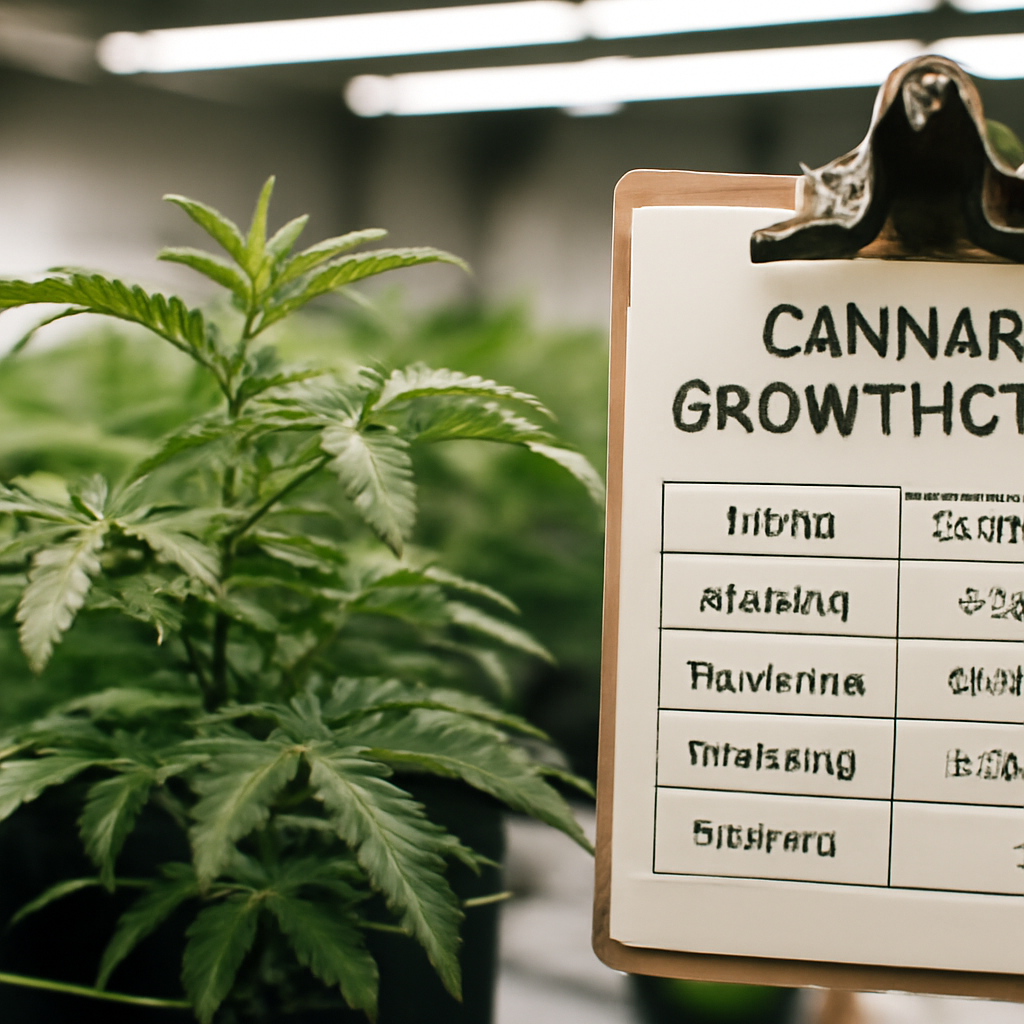
The chart above shows how a typical photoperiod cannabis grow flows indoors. Each stage has distinct environmental targets and feeding requirements. Let's go through each one with the actual numbers you need.
Stage 1 & 2: Germination and Seedling (Days 1–21)
Germination takes 1–5 days at 70–80°F (21–27°C) with high humidity — 70–80% RH. Keep VPD low here, around 0.4–0.6 kPa. The taproot is fragile and the plant can't handle any stress yet.
Once the seedling emerges, your cannabis growth chart entries should reflect:
- Light: 200–400 µmol/m²/s PPFD — CFLs, a T5, or LED dimmed back significantly. 18/6 light schedule.
- Temperature: 72–80°F (22–27°C), lights on. Keep the root zone slightly cooler — 68–72°F.
- Humidity: 65–75% RH. Use a dome if you're in a dry environment.
- Watering: Small amounts around the stem base only. No nutrients yet, or a very dilute seedling formula (EC 0.4–0.6).
- Medium: 63.3% of Grow Guide users grow in soil — for seedlings in soil, hold off on any added nutrients until week 2–3 unless you're seeing yellowing.
At day 14–21, look for 3–4 nodes and healthy true leaves. That's your signal to transition. See our guide on best nutrients for cannabis seedlings for specific product recommendations at this stage.
Stage 3 & 4: Vegetative Growth (Weeks 2–8)
This is where your cannabis growth chart entries get busier. Veg is the phase where structure is built — root volume, internodal spacing, and canopy shape all define what your flowering stage will produce. Rush it and you'll harvest light. Nail it and yields scale accordingly; use the Yield Calculator to model what canopy size means in grams.
Early Veg (Weeks 2–4):
- PPFD: 400–600 µmol/m²/s
- VPD: 0.8–1.0 kPa
- EC: 1.0–1.4 (soil), 1.2–1.6 (coco)
- pH: 6.0–7.0 (soil), 5.8–6.2 (coco/hydro)
- Temp: 70–82°F (21–28°C), lights on
- Humidity: 55–65% RH
Late Veg (Weeks 4–8): This is when training pays off. SCROG or LST during late veg builds a flat, even canopy that intercepts light uniformly. Start topping or FIMming by week 3–4 at the latest — read our FIMming vs Topping guide for the technique breakdown.
- PPFD: 600–900 µmol/m²/s
- VPD: 1.0–1.3 kPa
- EC: 1.4–2.0
- Nitrogen demand peaks here — look for deep green leaves. Any yellowing from the bottom up is a nitrogen deficiency; run it through the Nutrient Deficiency Identifier.
- CO₂ supplementation at 1,200–1,500 ppm meaningfully boosts growth at this stage if light levels are above 800 µmol/m²/s.
Cannabis Growth Chart for the Flowering Stage (Weeks 1–10+)
Flowering is where your cannabis growth chart does the most work. Split it into three phases:
Transition / Stretch (Weeks 1–3): The plant switches from 18/6 to 12/12 and doubles in height over 10–14 days. Don't panic — that's normal. Keep feeding nitrogen through week 2, then begin the transition to a bloom formula. PPFD: 700–900 µmol/m²/s. VPD: 1.1–1.4 kPa. EC: 1.6–2.0.
Peak Flower (Weeks 4–6): Bud sites stack. This is peak nutrient demand. Phosphorus and potassium drive calyx production. Drop nitrogen to 10–15% of total N-P-K. PPFD should hit 900–1,000 µmol/m²/s. Use the Grow Light Calculator to confirm your fixture is delivering that to canopy level. EC: 2.0–2.4. VPD: 1.2–1.5 kPa. Humidity now matters critically — keep it below 55% RH to prevent botrytis in dense buds.
Ripening & Flush (Weeks 7–8+): Trichomes shift from clear → cloudy → amber. Most growers harvest at 70–90% cloudy with 10–20% amber for a balanced high. Flush 1–2 weeks before harvest with pH-adjusted water only. Drop EC to near zero, PPFD back to 600–700. Check the Dry & Cure Timer so you're ready to process the harvest as soon as you cut.
Environmental Targets Across the Entire Cannabis Growth Chart
Harvest, Drying, and Curing: The Final Phase of the Cannabis Growth Chart
Most first-time growers harvest too early. Trichome inspection under 60–100× magnification is the most reliable harvest trigger. Clear trichomes = too early. Milky/cloudy = peak THC. Amber = degrading to CBN, which adds body effect. Target 10–20% amber for the typical high-intensity harvest window.
Once cut, the post-harvest leg of the cannabis growth chart runs like this:
- Drying: Hang whole branches in darkness, 60–70°F (15–21°C), 55–60% RH. No direct airflow on buds. Takes 7–10 days. Test: small stems snap cleanly = dry enough to jar.
- Initial Cure (Week 1–2): Fill glass mason jars to 75% capacity. Store in cool, dark location. Open (burp) once or twice daily for 5–10 minutes to release CO₂ and moisture.
- Extended Cure (Weeks 2–8): After two weeks, burp every 2–3 days. Flavor and smoothness peak between 4–8 weeks of curing. Terpene complexity develops significantly after week 3. Explore terpene profiles with the Terpene Explorer.
If you smell ammonia when you open the jar, the buds weren't dry enough — remove from jars immediately and dry for another 24–48 hours before re-jarring. Use the Dry & Cure Timer to track burp schedules and target moisture windows.
How to Use Your Cannabis Growth Chart as a Live Grow Journal
A growth chart is only useful if you're recording against it in real time. The most effective approach is daily or every-other-day entries with these data points: lights-on temp, lights-off temp, RH%, any feeding (EC in, EC runoff, pH), watering volume, and visual observations (leaf color, stem rigidity, pistil color in flower).
Pattern recognition is where the chart pays dividends. If your EC runoff is consistently 0.5+ above input EC, salts are building — flush. If VPD has crept above 1.6 kPa in late flower, you're losing moisture faster than the plant can move it and stress will show in leaves within 48 hours.
For a complete walkthrough on structuring your records, see our Cannabis Grow Diary: Complete Guide. To build a pre-planned version of this chart before your next run, use the Grow Schedule Planner — it generates a week-by-week feeding and environment schedule based on your strain type, medium, and light setup.
Once your grow is complete, run your numbers through the Cost Per Gram Calculator to understand your actual production cost — and benchmark what changes would improve efficiency on the next run.
Frequently Asked Questions
How long does each cannabis growth stage take indoors?
Germination takes 1–5 days; seedling stage runs days 3–21; vegetative stage lasts 4–8 weeks depending on desired plant size; flowering runs 7–10 weeks depending on strain genetics; and drying/curing adds 4–10 weeks. Total seed-to-cured-flower time for a photoperiod strain indoors is typically 16–24 weeks.
What should EC be at each stage of the cannabis growth chart?
In soil: seedling 0.4–0.6, early veg 1.0–1.4, late veg 1.4–2.0, early flower 1.6–2.0, peak flower 2.0–2.4, flush 0–0.4. Coco growers should push EC roughly 0.2–0.4 higher at each stage due to more frequent irrigation and faster nutrient cycling.
What PPFD should cannabis get during flowering?
During early flower, target 700–900 µmol/m²/s. Peak flower (weeks 4–6) can push to 900–1,000+ µmol/m²/s with CO₂ supplementation. Back off to 600–700 µmol/m²/s during the final flush week. Always verify actual canopy-level PPFD using a PAR meter, not manufacturer specs.
How do I know when to transition from veg to flower?
Switch to 12/12 when your plant has reached roughly half the final height you want — it will double in size during the stretch phase of weeks 1–3 of flower. For most indoor setups, this means switching at 30–50 cm tall, after 4–6 weeks of veg.
Can I use this cannabis growth chart for autoflowers?
Yes, with adjustments. Autoflowers skip the 12/12 trigger and run on a fixed internal clock — usually 8–10 weeks total from seed. The environmental targets (VPD, EC, PPFD, temperature) stay the same per stage, but stage durations are compressed. Veg typically lasts only 3–4 weeks before flower initiates automatically.
References
- Cervantes, J. (2015). The Cannabis Encyclopedia. Van Patten Publishing. Comprehensive reference covering growth stages, environmental requirements, and nutrient management for cannabis cultivation. cannabisencyclopedia.com
- Chandra, S., Lata, H., & ElSohly, M.A. (2017). "Light dependence of photosynthesis and water vapor exchange characteristics in different high Δ⁹-THC yielding varieties of Cannabis sativa L." Journal of Applied Research on Medicinal and Aromatic Plants. Establishes optimal PPFD ranges and CO₂ response curves for cannabis under controlled environments. doi.org/10.1016/j.jarmap.2016.11.004
- Chouquer, G. & Fortier, J.-F. (2020). "Vapor Pressure Deficit Management in Controlled Environment Agriculture." Acta Horticulturae. Documents VPD targets across plant growth stages and their effect on transpiration rates and nutrient uptake efficiency. actahort.org
- MMJ.com Editorial Team (2024). "Drying and Curing Cannabis: A Complete Guide." Details temperature, humidity, and timeline best practices for post-harvest dry and cure to preserve terpenes and prevent mold. mmj.com/learn/guides/drying-curing-cannabis/
- Grow Guide Platform Data (2026). Internal dataset of 1,000 tracked grow journals. Shows 73.2% of tracked grows are indoor, 63.3% use soil as a primary medium, and 54.6% use manual feeding — informing stage-specific recommendations in this guide. growguide.app