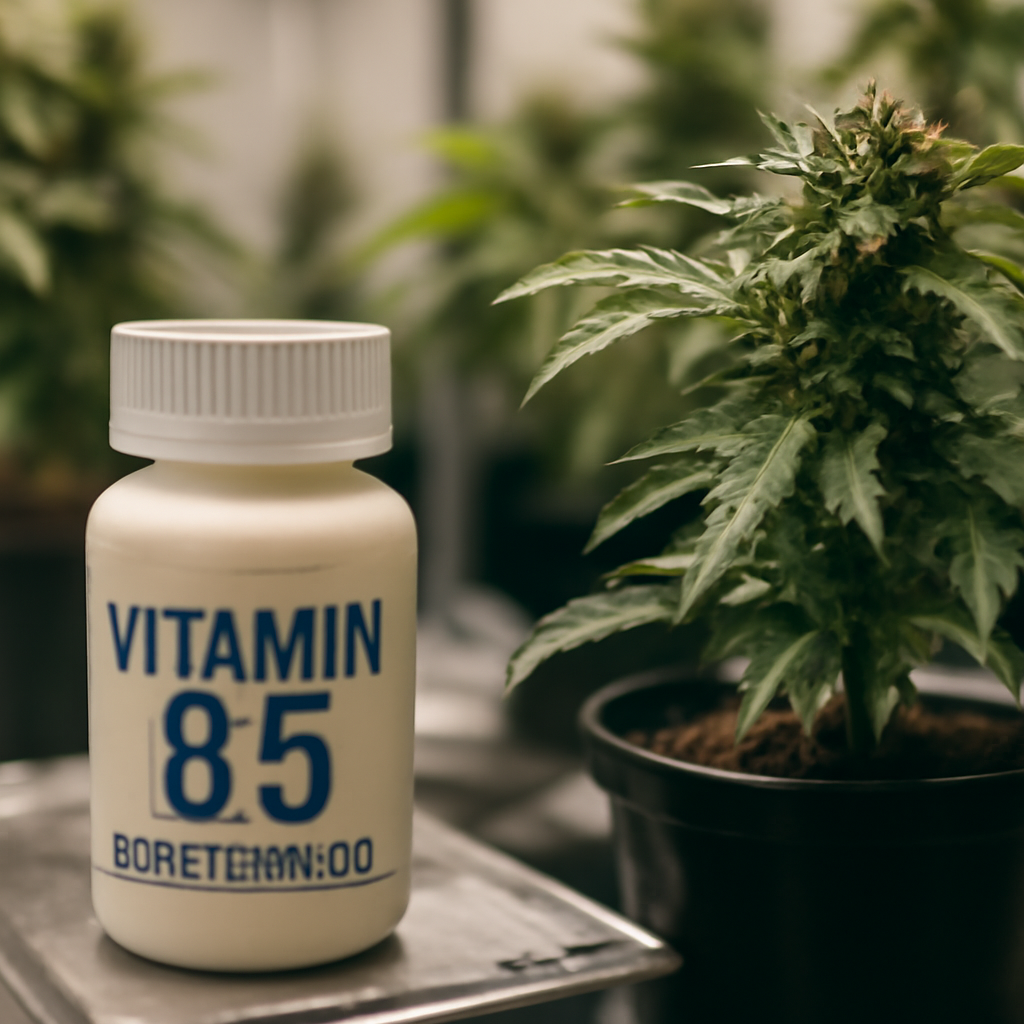
What Is B5 and Why Does It Matter in Cannabis Cultivation?
B5 — pantothenic acid — isn't a macro or micronutrient in the traditional NPK sense, but it plays a quietly critical role in how your cannabis plant converts sugars into usable energy. It's a core component of Coenzyme A (CoA), the molecule that sits at the center of cellular respiration and fatty acid synthesis. Without adequate B5, your plant can't efficiently metabolize carbohydrates, which means sluggish root development, poor cell wall integrity, and a noticeably weaker response to environmental stress like heat or drought.
Most discussion around cannabis nutrition focuses on N, P, K, calcium, magnesium, and iron. B5 rarely gets headline treatment — which is exactly why deficiencies go undiagnosed for longer than they should. If you're running a living soil with plenty of organic matter, microbial activity typically synthesizes enough pantothenic acid at the root zone. But in sterile coco coir, deep water culture, or heavily leached soils, B5 can drop to limiting levels fast.
According to Grow Guide platform data, 633 out of 1,000 tracked grows use soil as their primary medium — and those growers likely have enough microbial B5 production to stay out of trouble. The remaining 148 coco and 73 "other" medium growers are the ones most at risk of running low, especially in long vegetative cycles.
B5 Deficiency in Cannabis: Symptoms and Identification
Pantothenic acid deficiency doesn't announce itself loudly. You won't see the dramatic purple stems of a phosphorus problem or the bright interveinal yellowing of magnesium deficiency. B5 deficiency tends to look like generalized stress — and that's what makes it hard to catch without a systematic approach.
Classic B5 deficiency signs include:
- Leaf tip and margin necrosis on mid-canopy leaves — starts at the tips, works inward, looks like a mild calcium or potassium issue at first
- Slowed growth rate in vegetative stage — plants look healthy at a glance but just aren't putting on size at the rate they should
- Wilting under moderate heat — B5 supports fatty acid synthesis in cell membranes, so plants without it lose turgor pressure faster
- Reduced root mass — you'll notice this most when transplanting; roots look sparse and white rather than dense and branching
- Delayed flowering transition — in severe cases, the metabolic slowdown can push back flower initiation by several days
Confusingly, B5 deficiency symptoms overlap with early calcium deficiency, salt stress, and even mild overwatering. If you've ruled those out and symptoms persist on a clean feed schedule, B5 is worth investigating. Use the Nutrient Deficiency Identifier to cross-reference your symptom pattern before adjusting your feed.
Which Grows Need B5 Supplementation?
Not every grow needs added B5. Here's a practical breakdown by medium:
Soil Grows
Living soil and quality amended mixes (with compost, worm castings, or mycorrhizal inoculants) produce B5 through microbial synthesis. If you're running a well-colonized soil with active biology, your plants are almost certainly getting adequate pantothenic acid without any supplement. Of the 633 soil growers tracked on Grow Guide, most running organic or amended soils won't need to address B5 directly. See our guide on best organic nutrients for cannabis for building a solid soil baseline.
Coco Coir Grows
Coco is sterile. There's no microbial population producing B5, so you're entirely dependent on what you feed. If your base nutrient line doesn't include a vitamin B complex, you're likely running low on pantothenic acid by week 4–5 of veg. This is when symptoms typically first appear. Supplement with a B-vitamin additive at 1–2 mL/gallon during vegetative stage.
Hydro / DWC
Same situation as coco — fully dependent on your nutrient solution. In DWC, B5 depletion can happen faster because roots are constantly bathed in solution and uptake rates are high. Dose at 1–5 mL/gallon depending on the product, and check your EC to ensure you're not pushing total dissolved solids too high. Target EC 1.2–2.0 in veg, 1.6–2.4 in flower, keeping pH at 5.8–6.2 for hydro systems.
How to Use B5 Products in Your Feed Schedule
B5 supplements for cannabis typically come as part of a broader vitamin B complex — products like Botanicare Hydroguard+, Aptus Regulator, or Great White contain B vitamins including pantothenic acid. Pure pantothenic acid supplements also exist. Here's how to integrate B5 into your grow:
Timing B5 Applications
- Seedling stage (days 1–14): Hold off on B5 additives. Seedlings are sensitive and a high-quality starter soil or seedling mix will cover their needs. See our seedling nutrient guide for full detail.
- Early to mid vegetative (weeks 2–6): This is the primary window for B5 application. Roots are expanding fast, CoA demand is high, and the plant is building the metabolic infrastructure it will rely on through flower. Apply B-vitamin supplement at manufacturer's recommended rate or 1–3 mL/gallon in coco/hydro.
- Late vegetative / pre-flower transition: Continue B5 supplementation. Energy demands peak as the plant prepares for flowering. Don't drop B5 here.
- Flower (weeks 1–8): You can taper B5 down after week 4 of flower. The metabolic priority shifts toward phosphorus and potassium utilization, and flowering nutrient lines often include B vitamins anyway. Check your bottle labels.
- Flush / final weeks: Drop all additives, including B vitamins, during flush.
Mixing and pH Notes
B5 supplements are water-soluble and mix easily. Add them after your base nutrients and before pH adjustment. Most B vitamin additives are slightly acidic — pH your solution to 5.8–6.2 for hydro/coco, or 6.0–6.8 for soil after mixing everything. EC impact from B vitamin additives is minimal (typically +0.1–0.2 EC per standard dose) but always check your pen. Map your feed week by week with the Grow Schedule Planner to stay consistent.
B5 and Plant Stress Resilience
One underrated benefit of maintaining adequate B5 levels is improved tolerance to environmental stress. Pantothenic acid plays a role in synthesizing the lipid components of cell membranes. Plants with healthy membrane integrity recover faster from heat stress, wilting events, and pH swings. If you're running a grow with high daytime temperatures (above 85°F/29°C) or variable humidity, keeping B5 levels topped up acts as a buffer against stress-related yield loss.
This matters in the real world. An indoor grow operating at 82°F during lights-on with VPD at 1.2–1.5 kPa in flower is already asking a lot of the plant's regulatory systems. Adequate pantothenic acid means the plant can maintain turgor, synthesize stress proteins more efficiently, and keep photosynthesis running cleanly under load.
Diagnosing vs. Over-Supplementing B5
You cannot easily overdose on B5 — it's water-soluble and excess is flushed out. That said, chasing a suspected B5 deficiency by throwing multiple vitamin products at the plant simultaneously is a recipe for EC creep and lockout. The correct sequence is:
- Confirm your pH is dialed (6.0–6.8 soil, 5.8–6.2 coco/hydro) — pH is the most common reason for apparent deficiencies
- Check EC — are you feeding at an appropriate concentration? (EC 1.2–1.6 veg, 1.6–2.2 flower as a baseline)
- Rule out calcium deficiency — symptoms overlap significantly
- If pH and EC are correct and calcium is ruled out, introduce a B-vitamin complex at half dose for one week and observe
- If growth accelerates and tip necrosis stops progressing within 5–7 days, you had a B5 (or broader B vitamin) issue
For tracking this systematically, a grow diary is invaluable — noting feed schedules, symptoms by date, and growth rate changes gives you the data to diagnose accurately. Use the Grow Schedule Planner to map your nutrient changes against plant response.
Top B5 Supplement Products for Cannabis
Most purpose-built cannabis vitamin supplements include B5 alongside B1 (thiamine) and B2 (riboflavin) since these vitamins work together in the Krebs cycle. Look for these when shopping:
- Botanicare B+ (B Vitamins): A clean, well-formulated B-vitamin supplement widely used in coco and hydro grows. Contains B1, B2, B3, B5, and B6.
- Aptus Regulator: Amino acid and B-vitamin blend with pantothenic acid. Particularly effective for stress recovery and root stimulation.
- General Hydroponics Rapid Start: Root stimulator that includes B vitamins as part of its formula — good for early veg on sterile media.
- Organic compost tea: If you're in soil, a weekly low-dose aerated compost tea will stimulate microbial populations that produce B5 naturally — no bottle required.
Whatever product you use, add B5 supplementation to your regular feed tracking. The Cost Per Gram Calculator can help you decide whether commercial B-vitamin additives are worth the input cost relative to your expected yield.
B5 During Dry and Cure: Does It Matter?
Once you've harvested, B5 has done its work. Post-harvest, your focus shifts to managing moisture, terpene retention, and preventing mold. Dry at 60–65°F with 55–62% RH for 7–10 days, then cure in airtight glass jars at 60–65°F, burping daily for the first two weeks. Use the Dry & Cure Timer to track your exact timeline. Adequate B5 during the grow may indirectly support a better cure by producing denser buds with better structural integrity — but it won't rescue a poor dry environment.
Frequently Asked Questions
What is B5 used for in cannabis growing?
B5 (pantothenic acid) is used in cannabis cultivation as a nutritional supplement to support energy metabolism, root development, and stress tolerance. It's a precursor to Coenzyme A, which cannabis plants need to convert sugars into usable cellular energy. It's most important in sterile media like coco coir and hydroponics where microbial synthesis doesn't occur.
How do I know if my cannabis plant has a B5 deficiency?
B5 deficiency typically shows as leaf tip and margin necrosis on mid-canopy leaves, slowed vegetative growth, increased wilting under heat, and sparse root development. Symptoms look similar to early calcium deficiency. Confirm by ruling out pH issues (target 6.0–6.8 soil, 5.8–6.2 hydro/coco) and calcium lockout first, then trial a B-vitamin supplement at half dose for one week.
Do soil growers need to supplement with B5?
Usually not. Living and amended soils with active microbial populations synthesize pantothenic acid at the root zone. Growers using compost, worm castings, or mycorrhizal inoculants rarely need to add B5 separately. Coco coir and hydro growers are the primary target for B5 supplementation since those media are sterile.
Can you overdose cannabis plants with B5?
B5 is water-soluble and excess is excreted rather than accumulated, so direct B5 toxicity is extremely unlikely at standard doses (1–5 mL/gallon). The real risk is adding multiple vitamin products simultaneously and raising your EC too high, which can cause nutrient lockout. Always check your total EC when adding supplements.
When should I stop giving B5 to my cannabis plants?
Taper B5 supplementation down after week 4 of flowering and stop it entirely during your pre-harvest flush (the final 7–14 days). Peak demand for pantothenic acid is during the vegetative stage when root systems and cellular infrastructure are being built.
References
- Hanson, B. (2004). Pantothenic Acid (Vitamin B5): Function and Plant Requirements. University of California Cooperative Extension. Pantothenic acid is described as essential for Coenzyme A biosynthesis, which drives acetyl-CoA production central to carbohydrate and fatty acid metabolism in plant cells. ucanr.edu
- Taiz, L. & Zeiger, E. (2010). Plant Physiology, 5th Edition. Sinauer Associates. Covers the biochemical role of coenzymes derived from B vitamins, including pantothenic acid's role in the Krebs cycle and lipid synthesis pathways in vascular plants.
- Cervantes, J. (2015). The Cannabis Encyclopedia. Van Patten Publishing. Documents the practical effects of B-vitamin deficiencies in cannabis cultivation, including symptom progression and recovery protocols in soil and hydroponic systems.
- Bugbee, B. (2016). Nutrient Management in Recirculating Hydroponic Culture. Utah State University. Notes that water-soluble vitamins including pantothenic acid are absent from inorganic hydroponic nutrient solutions and must be supplemented or provided through organic matter. digitalcommons.usu.edu
- GrowWeedEasy.com (2024). Cannabis Drying and Curing Guide. Practical guidance on post-harvest moisture management; 60–65°F at 55–62% RH recommended for 7–10 day dry phase. growweedeasy.com/curing