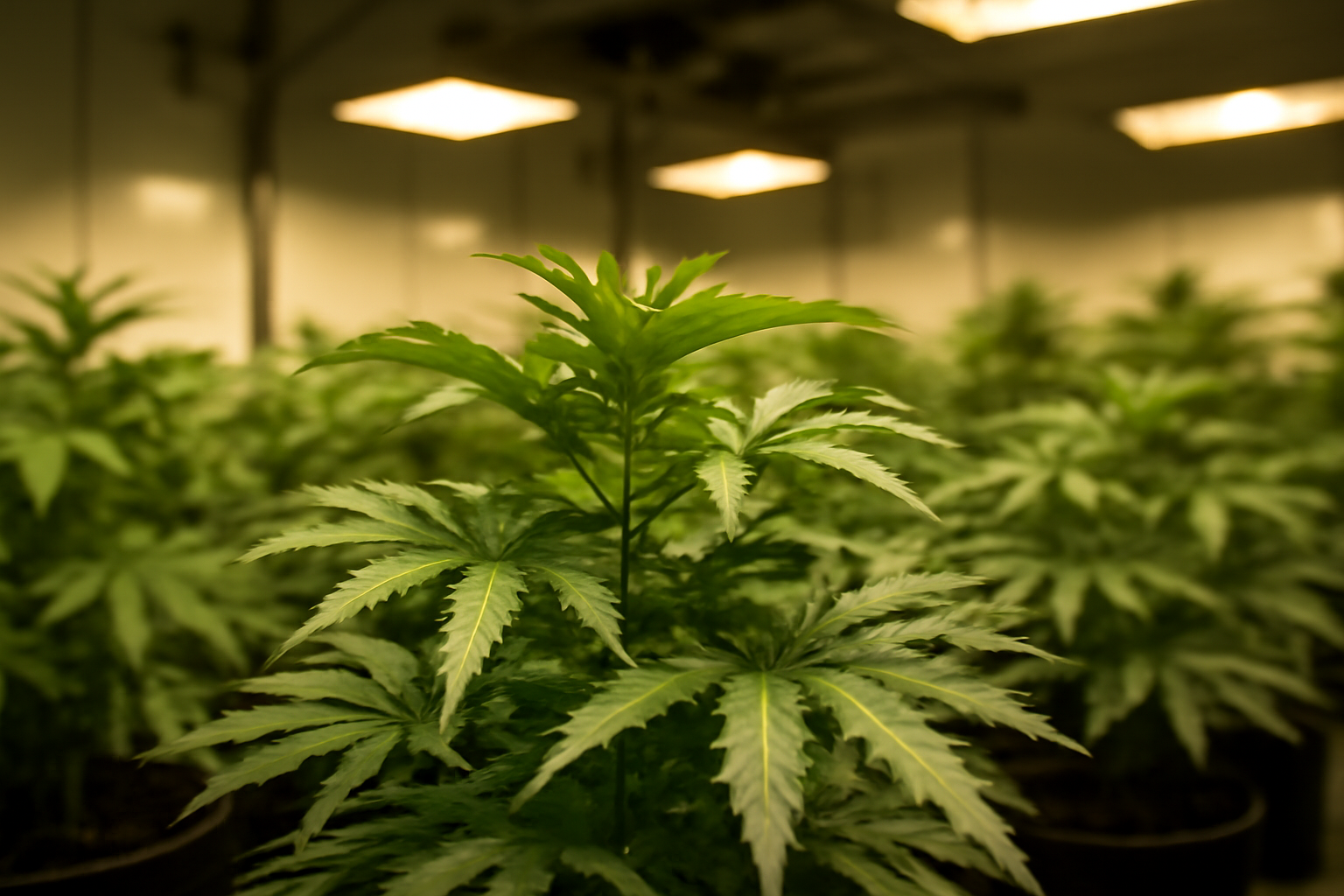
What the Vegetative Stage Actually Looks Like, Week by Week
If you've got seedlings under lights and you're wondering whether they're on track, this is the guide for you. Vegetative stage week by week pictures for indoor grows are exactly what new and intermediate growers search for — because knowing the numbers is one thing, but seeing what a healthy plant looks like at day 14 versus day 42 is another. This guide walks you through every week of veg with specific visual cues, environmental targets, and what to do if something looks off. Of the 1,000 grow journals tracked on Grow Guide, 737 are indoor grows — so the data below reflects real indoor conditions, not theory.
Week 1 of Veg: First True Leaves
Your seedling officially enters the vegetative stage around day 10–14 from germination — once the cotyledons (those round starter leaves) are fully open and the first set of true serrated cannabis leaves is visible. At this point your plant is typically 2–4 cm tall with a thin, pale green stem.
What it looks like: One node, two cotyledons, and the first true single-finger leaves emerging from the centre. The leaves are small and slightly glossy. Internodal spacing is very tight — nodes almost stack on top of each other.
Targets this week:
- Light: 18/6 schedule, PPFD ~200–300 µmol/m²/s at canopy (don't blast seedlings)
- Temp: 22–25°C day / 18–20°C night
- RH: 60–70% (seedlings love humidity)
- Watering: small amounts around the base, not saturating — roots are tiny
- EC: 0.4–0.6 if feeding, or plain water if in pre-amended soil
- pH: 6.0–6.5 in soil, 5.5–6.0 in coco
Don't overfeed. More seedlings are killed by enthusiasm than neglect. If you're not sure what your seedlings need, check our Best Nutrients for Cannabis Seedlings guide.
Weeks 2–3: Exponential Growth Begins
This is where vegetative stage week by week pictures start to look dramatically different between days. Plants can genuinely double in size every 5–7 days under good conditions. You'll see 3–5 nodes developing, fan leaves widening, and the stem thickening noticeably.
What it looks like at week 2: 5–10 cm tall, 3 nodes visible, fan leaves with 3–5 fingers. Stem still thin but starting to show faint purple striping if temps are on the cooler side — totally normal.
What it looks like at week 3: 10–20 cm tall, 4–6 nodes, leaves with 7 fingers on mature fan leaves. Branching begins — you'll see tiny lateral shoots appearing at each node. Roots are actively colonising the container.
Targets weeks 2–3:
- PPFD: 400–600 µmol/m²/s
- EC: 0.8–1.2 (nitrogen-forward feed)
- RH: 50–65%
- Temp: 22–26°C
- VPD: 0.8–1.2 kPa
Ramp up nitrogen. N is the single most important macronutrient in veg — it drives every green cell in the plant. A 3-1-2 NPK ratio feed works well here. If leaves look pale lime-green rather than deep green, you're likely underfeeding N. Use the Nutrient Deficiency Identifier to confirm before adjusting.
Weeks 4–6: Training Window — The Most Important Phase
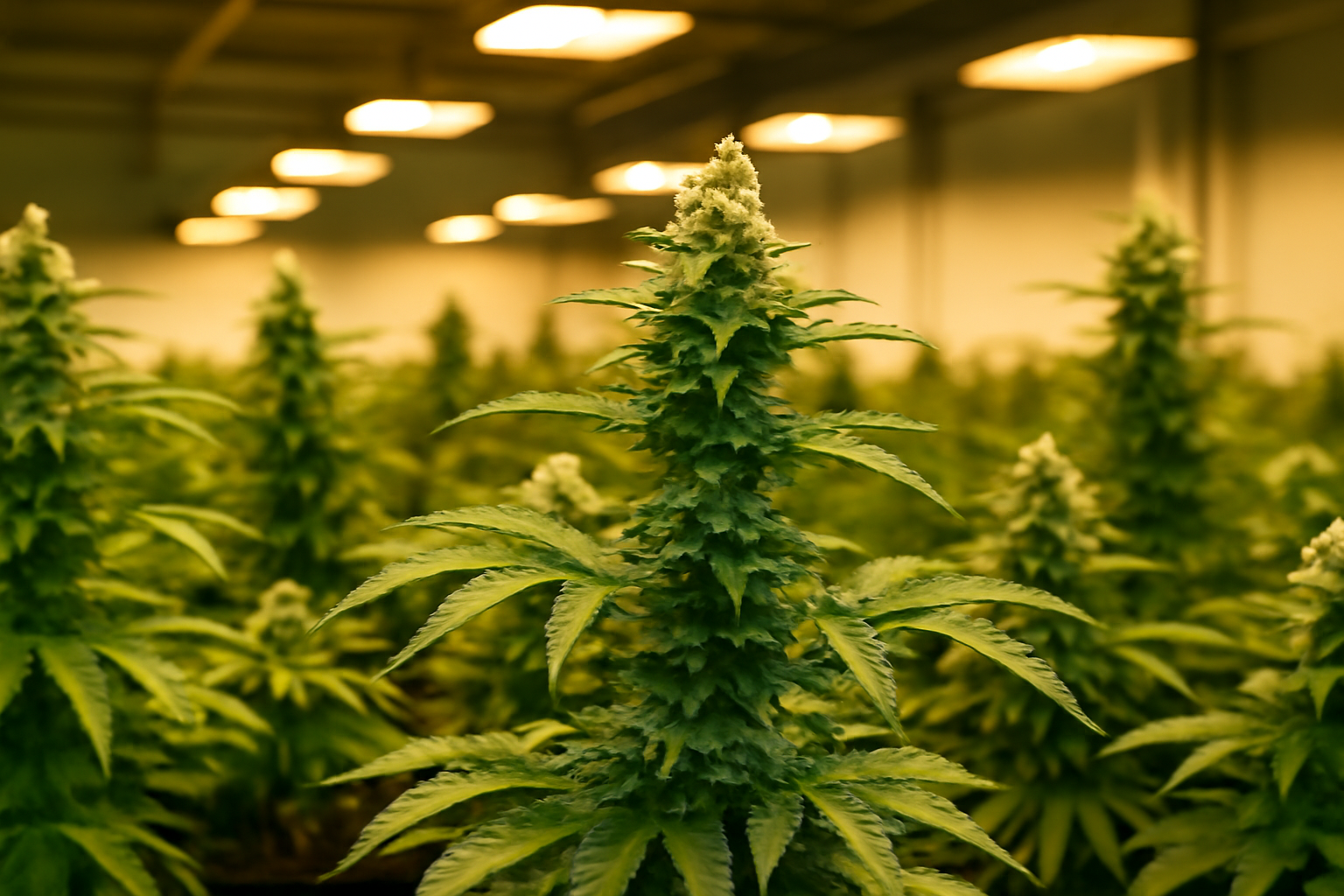
Weeks 4–6 are where indoor growers make or break their yield. Plants are now 20–50 cm tall with 6–9 nodes and strong lateral branching. This is the ideal vegetative stage training window because the stems are supple enough to bend without snapping, and you have enough growth to work with.
What it looks like at week 4: 25–35 cm, bushy, 6–7 nodes. If you topped in week 3, you'll see two main shoots competing for dominance — that's exactly what you want. Lateral branches reaching outward. Fan leaves are large with 7–9 fingers.
What it looks like at week 6: 35–55 cm in soil, potentially 20–30 cm in coco with faster root uptake. A well-trained plant at week 6 in a 5-gallon pot under a 600W LED should look like a flat, wide bush — not a Christmas tree. Multiple bud sites are at roughly the same height.
Training techniques to use now:
- LST (Low-Stress Training): Bend the main stem horizontally and secure it. Forces lateral branches up and creates an even canopy. Do this from week 3 onwards.
- Topping: Remove the apical meristem (growing tip) to create two dominant colas. Best done at node 4–6 during week 3–4. See our Fimming vs Topping guide for a detailed comparison.
- SCROG (Screen of Green): Weave branches through a net at 20–30 cm above the pot to create a level canopy. Most effective during weeks 4–6.
Nutrient targets weeks 4–6:
- EC: 1.2–1.8
- N-P-K direction: high N, moderate P, moderate-high K
- Cal-Mag: 2–5 ml/L if running RO water or in coco
- pH: 6.0–6.5 soil / 5.8–6.0 coco
Use the Grow Schedule Planner to map out exactly when to top, train, and feed so nothing falls through the cracks.
Weeks 7–8: Pre-Flowers and the Flip Decision
By week 7, most photoperiod indoor plants are approaching sexual maturity. This is one of the most exciting moments in the vegetative stage — pre-flowers appear at the nodes, and you can finally confirm sex without flipping to 12/12.
What it looks like at week 7: 45–70 cm depending on strain and training. Nodes are stacking faster. Pre-flowers visible as tiny white pistils (female) or small pollen sacs (male) at the junction between stem and branch. Female pre-flowers look like two white hairs emerging from a tiny calyx.
What it looks like at week 8: Plants are nearing their flip-ready size. Remember the rule of thumb: cannabis typically doubles in size during early flower. If your tent ceiling is at 120 cm and your plant is 60 cm, you're at the limit. Plan your flip accordingly.
Environmental targets weeks 7–8:
- RH: 40–55% (start reducing ahead of flower)
- Temp: 22–26°C
- PPFD: 600–900 µmol/m²/s
- VPD: 1.0–1.4 kPa
Use our Grow Light Calculator to check whether your current setup is delivering enough PPFD at canopy level before you flip.
Vegetative Stage Week by Week: Common Problems With Pictures in Mind
When growers search for vegetative stage week by week pictures, they're often trying to match a symptom they're seeing against a healthy reference. Here's what goes wrong and how to fix it fast:
| Symptom | Most Likely Cause | Fix |
|---|---|---|
| Yellowing lower leaves, weeks 3–5 | Nitrogen deficiency | Increase N feed, check pH first (lockout mimics deficiency) |
| Purple stems, week 1–3 | Phosphorus deficiency or cold temps | Raise temps to 22°C+, add small P supplement if persists |
| Curling leaves (clawing), any week | Nitrogen toxicity or overwatering | Flush with plain pH'd water, reduce EC by 0.4 |
| Slow growth, weeks 2–4 | Low PPFD, root-bound, or pH drift | Check light distance, up-pot if needed, calibrate pH meter |
| Brown spots on fan leaves | Calcium or magnesium deficiency | Add Cal-Mag, check coco or RO water grows especially |
| Stretchy, pale growth | Light too far away or underpowered | Lower light or increase intensity; target 400–700 PPFD |
If you're unsure what you're looking at, the Nutrient Deficiency Identifier lets you input symptoms and get a likely diagnosis based on visual cues.
Lighting for the Vegetative Stage
Indoor veg lighting is one of the most impactful variables you control. The 18/6 photoperiod (18 hours light, 6 dark) is the most common across indoor grows on this platform. Some growers run 20/4 for faster growth; 24/0 is occasionally used but removes the natural dark-period hormone cycle that some strains need.
Spectrum: Blue-dominant light (5000–7000K) promotes compact, bushy vegetative growth. Most modern full-spectrum LEDs do this well without swapping bulbs. If you're on HID, metal halide bulbs are the veg standard.
PPFD targets by week:
- Week 1: 200–350 µmol/m²/s
- Weeks 2–3: 400–600 µmol/m²/s
- Weeks 4–6: 600–800 µmol/m²/s
- Weeks 7–8: 700–900 µmol/m²/s
DLI (Daily Light Integral) in veg should sit between 25–40 mol/m²/day. At 18/6 and 600 PPFD, you're hitting approximately 38.9 mol/m²/day — right in the sweet spot.
Documenting Your Grow: Why Photos Matter
The single best thing you can do alongside reading about vegetative stage week by week pictures is take your own. A photo a day takes 30 seconds and gives you a reference library that'll help you diagnose problems faster every future grow. Date-stamped photos matched to feeding and environmental notes are worth more than any generic chart.
If you want a structured way to log your grow, check out our guide on How to Keep a Cannabis Grow Diary or the full Cannabis Grow Diary: Complete Guide. Track photos, EC, pH, temps, and training notes in one place — when something goes wrong in week 5, you'll be able to trace it back immediately.
Want to know what your veg-trained plant could yield? Plug your numbers into the Yield Calculator to get a realistic estimate before you flip to flower.
Preparing for the Flip
The end of veg isn't just about size — it's about readiness. Before switching to 12/12, run through this checklist:
- Plant is 50–60% of your available canopy height (accounting for stretch)
- At least 4–6 well-developed bud sites visible after training
- No active deficiencies or pest pressure
- Pre-flowers visible to confirm female sex
- Root system filling the container (slight root curl at drainage holes)
- EC and pH stable for at least 2 weeks
For a complete picture of how long your full grow will take from seed to harvest, see How Long to Grow Cannabis Indoors.
Frequently Asked Questions
How tall should my cannabis plant be at the end of the vegetative stage?
It depends on your setup, but for a typical 1.2 m indoor tent, aim for 40–65 cm before flipping to flower. Cannabis usually doubles in height during early flowering, so a 60 cm plant at flip could reach 120 cm — right at the ceiling limit. Adjust based on your available vertical space.
How long should I veg my cannabis plant indoors?
Most indoor photoperiod grows veg for 4–8 weeks. Four weeks gives you a compact plant with fewer bud sites; 8 weeks gives you a large, well-trained plant with many colas and higher yield potential. Autoflowers veg on their own schedule (typically 3–5 weeks) regardless of light cycle.
What nutrients does cannabis need most during the vegetative stage?
Nitrogen is the primary driver of vegetative growth — it's needed for chlorophyll, protein, and leaf production. You also need adequate calcium and magnesium (especially in coco or with RO water), and moderate phosphorus and potassium. A balanced N-P-K like 3-1-2 at EC 1.0–1.8 covers most of veg.
When can I tell if my cannabis plant is male or female?
Pre-flowers typically appear at weeks 7–8 of vegetative growth once the plant reaches sexual maturity — even under 18/6 light. Female pre-flowers show as two white pistils (hairs) at the node; male pre-flowers look like tiny round balls on a short stalk. You don't need to flip to 12/12 to sex your plant — just wait for the nodes to mature.
Why is my cannabis plant growing slowly in the vegetative stage?
The four most common causes are: insufficient PPFD (light too far away or underpowered), pH out of range causing nutrient lockout, root-bound conditions in a too-small pot, or overwatering reducing oxygen to roots. Check these in order — pH and light are the most common culprits. Recalibrate your pH meter if it's more than a few months old.