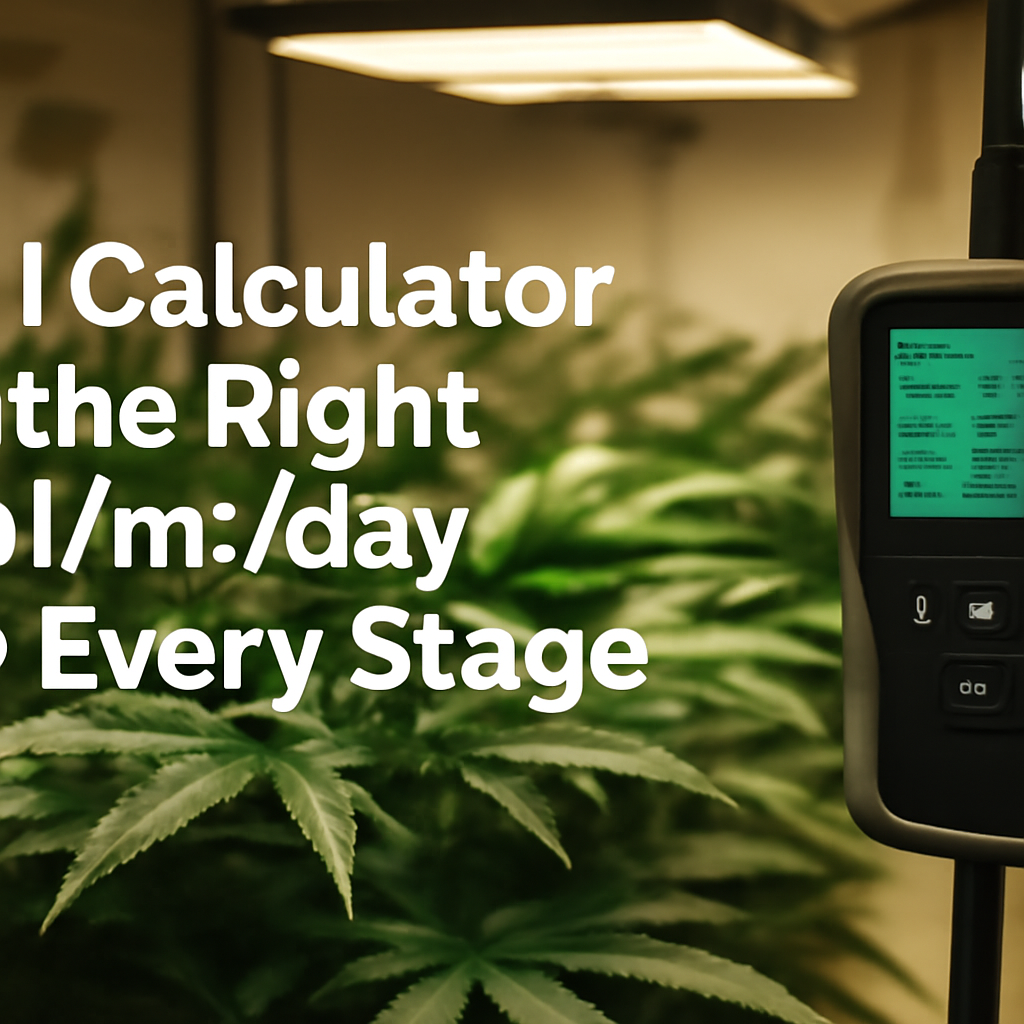
What Is DLI and Why Should Growers Care?
If you've been dialing in VPD, EC, and pH but ignoring Daily Light Integral, you're leaving yield on the table. DLI is the total cumulative light energy your plant receives over a 24-hour period — not just how bright your light is at a single moment, but how much photosynthetically active radiation (PAR) actually accumulates from lights-on to lights-off. It's expressed in moles of photons per square meter per day (mol/m²/day), and it's the metric that connects your PPFD reading to real-world plant response.
PPFD tells you intensity at a snapshot in time. DLI tells you the full picture. A 1000 µmol/m²/s fixture running 18 hours delivers almost double the DLI of the same fixture running 10 hours. That difference shows up in internode spacing, bud density, resin production, and ultimately your harvest weight. According to data from Grow Guide's 1,000+ tracked grows, 73.4% of logged cultivations happen indoors — meaning the majority of growers have complete control over DLI and should be using a Grow Light Calculator to make every photon count.
The DLI Calculator Formula Explained
You don't need expensive software to use a DLI calculator. The formula is straightforward:
DLI = (PPFD × Photoperiod hours × 3600) ÷ 1,000,000
- PPFD — measured in µmol/m²/s at canopy level with a quantum sensor
- Photoperiod — number of hours your lights are on per day
- 3600 — converts hours to seconds
- 1,000,000 — converts micromoles to moles
Example: Running 600 µmol/m²/s for 18 hours (veg):
DLI = (600 × 18 × 3600) ÷ 1,000,000 = 38.9 mol/m²/day
That puts you right in the vegetative sweet spot. Switch to 12/12 for flower without bumping PPFD and your DLI drops to 25.9 — well below the 35–50 mol/m²/day that flowering cannabis demands. That's why experienced growers raise intensity at the flip, not just change the timer.
DLI Targets by Cannabis Growth Stage
Not every stage wants the same DLI. Blasting seedlings with 45 mol/m²/day will bleach them out; keeping late-flower plants at 20 mol/m²/day starves them of energy when they need it most. Here are the ranges that hold up across strains and growing systems:
| Growth Stage | Target DLI (mol/m²/day) | Typical PPFD (µmol/m²/s) | Photoperiod |
|---|---|---|---|
| Seedling / Clone | 15–25 | 200–350 | 18h |
| Early Vegetative | 25–35 | 400–550 | 18h |
| Late Vegetative | 35–40 | 550–750 | 18h |
| Early Flower (Wk 1–3) | 35–45 | 700–900 | 12h |
| Peak Flower (Wk 4–7) | 40–50 | 900–1100 | 12h |
| Late Flower / Flush | 35–40 | 700–900 | 12h |
Notice that the transition from veg to flower with a 12/12 timer is actually a DLI drop unless you compensate with higher PPFD. For a plant that was receiving 38.9 mol/m²/day at 600 µmol/m²/s on 18 hours, flipping to 12/12 at the same intensity gives you only 25.9 mol/m²/day — a 33% reduction right when flowers are forming. Bump PPFD to 900 µmol/m²/s on 12 hours and you're at 38.9 mol/m²/day, back in range and climbing toward peak flower targets.
How to Measure PPFD Before Using a DLI Calculator
Your DLI calculation is only as accurate as your PPFD reading. Here's the right way to measure it:
- Use a quantum sensor, not a lux meter. Lux is weighted for human vision, not plant response. A PAR meter or quantum sensor (like the Apogee SQ-520 or the Photone app with a calibrated diffuser) gives you µmol/m²/s readings that plug directly into the DLI formula.
- Measure at canopy level. Point the sensor upward at the same height as your tallest bud sites. This is the light that matters.
- Take a grid reading. Measure at 5–9 points across your canopy and average them. Hotspots under the center of a single fixture can be 30–50% brighter than the corners.
- Account for real hanging height. The inverse square law means moving your light 20cm closer can double intensity. Check PPFD every time you adjust your fixture.
Once you have an accurate PPFD average, plug it into our Grow Light Calculator to model DLI across different photoperiods and see whether your current setup hits stage-appropriate targets.
Using a DLI Calculator to Fix Common Light Problems
Problem: Stretchy, Airy Buds in Flower
If your buds are loose and your internodes are long, your DLI is almost certainly too low for flowering. Calculate your actual DLI using the formula above. If you're below 35 mol/m²/day in weeks 2–6 of flower, you need more photons. Your options: raise PPFD (lower the fixture or increase dimmer output), extend the dark period slightly within the 12/12 framework (not recommended — use intensity instead), or upgrade your fixture. A 315W CMH running 12 hours typically delivers 22–28 mol/m²/day — not enough for peak flower. A 600W HPS or a quality 480W LED can push you to 38–45 mol/m²/day at the right hanging height.
Problem: Bleaching or Light Burn on Top Colas
If tips are yellowing or whitening from the top down — especially on uppermost colas closest to the fixture — your DLI is too high at those points. Measure PPFD directly below the light at canopy height. If it's above 1200–1300 µmol/m²/s, raise the fixture 5–10cm and re-measure. Alternatively, use your dimmer to drop output by 10–15% and recalculate DLI. Even at 80% output, a well-placed 600W LED can deliver 45+ mol/m²/day — plenty for even the heaviest-feeding strains.
Problem: Slow Vegetative Growth
Slow veg with dark-green leaves and minimal internode extension often points to DLI that's too low — below 25 mol/m²/day. The easiest fix: extend your photoperiod. Going from 16h to 18h with the same PPFD bumps DLI by 12.5% without touching your fixture. If you're already on 18h and struggling, the fixture needs to get closer or brighter. Target 400–600 µmol/m²/s at canopy for vigorous veg growth in soil; coco growers pushing higher EC (1.8–2.4 mS/cm) can handle 600–750 µmol/m²/s and benefit from the higher DLI.
DLI and CO₂ Enrichment: How They Interact
At ambient CO₂ levels (~420 ppm), most cannabis strains hit light saturation around 900–1000 µmol/m²/s. Above that, photosynthesis plateaus and the extra photons generate heat without additional growth. But at 1200–1500 ppm CO₂, the light saturation point rises to 1200–1500 µmol/m²/s — meaning DLI targets also shift upward. If you're supplementing CO₂, your peak flower DLI ceiling effectively becomes 55–65 mol/m²/day rather than 50. This only makes economic sense with adequate HVAC to manage the heat from running lights at those intensities. Without CO₂ enrichment, chasing DLI above 50 mol/m²/day is diminishing returns — or damage.
DLI for Autoflowering Cannabis
Autoflowering varieties don't respond to photoperiod triggers, which means you have more flexibility with light schedules — but DLI still governs growth rate and yield. Most autos perform well on 18–20h photoperiods throughout their lifecycle. A PPFD of 500–700 µmol/m²/s on 20 hours gives you 36–50.4 mol/m²/day, which covers both veg and flower phases without any schedule changes. Running 24h on is generally not worth the electricity or the potential for mild light stress — the plant needs some dark period for metabolic processes even if it doesn't need it for flowering triggers. Use our Grow Schedule Planner to map out an auto's full timeline with consistent DLI across every week.
Tracking DLI Across a Full Grow
The growers who consistently pull heavy harvests aren't just hitting DLI targets once — they're tracking it week by week and adjusting as their canopy rises, their light degrades, or their plants develop. A simple grow journal log entry every 7–10 days with your PPFD reading and calculated DLI gives you an audit trail that pays off when something goes sideways. You can see exactly when DLI dropped (new bulb needed? Fixture drifted up? Timer failed?) and correlate it with plant response. Pair that with a Yield Calculator to see how light hours and intensity track against your actual harvest weight over multiple grows.
For more on building that habit into your grow, check out our guide on how to keep a cannabis grow diary — consistent logging turns DLI data into something you can actually act on.
Quick DLI Reference: Common Setups
Here's how some typical indoor setups land on the DLI scale without any adjustments:
- 315W CMH, 18h, ~450 µmol/m²/s: ~29.2 mol/m²/day — fine for veg, weak for flower
- 600W HPS, 18h, ~700 µmol/m²/s: ~45.4 mol/m²/day — excellent for veg, reduces to 30.2 on 12/12
- 480W LED (Samsung LM301H), 18h, ~750 µmol/m²/s: ~48.6 mol/m²/day — top-end veg, needs 12/12 DLI compensation
- 1000W DE HPS, 12h, ~1100 µmol/m²/s: ~47.5 mol/m²/day — solid peak flower DLI
- Spider Farmer SE7000, 12h, ~950 µmol/m²/s: ~41.0 mol/m²/day — well within flower target range
These numbers assume the sensor is at the ideal hanging height for each fixture. Real-world canopy PPFD varies significantly by room size, reflectivity, and plant height — always measure, don't assume.
Frequently Asked Questions
What is a good DLI for cannabis in flowering?
Most cannabis varieties in peak flower (weeks 4–7) perform best at 40–50 mol/m²/day. Early flower (weeks 1–3) can be slightly lower at 35–45 mol/m²/day. Going above 50 mol/m²/day without CO₂ enrichment is unlikely to increase yield and may cause light stress.
Can I use a DLI calculator without a PAR meter?
You can estimate PPFD using the Photone app on a smartphone with a full-spectrum diffuser attached to the lens — results are reasonable for hobbyist growers, typically within 10–15% of a dedicated quantum sensor. For the most accurate DLI calculations, a calibrated PAR meter like the Apogee SQ-520 is the gold standard. Without any PPFD measurement, DLI calculations are just guesses.
Does DLI matter for autoflowering cannabis?
Yes — arguably more so than for photoperiod strains because autos can't compensate for low light by extending their vegetative phase in response to your schedule. Target 35–50 mol/m²/day throughout the auto's lifecycle using 18–20h photoperiods and adjust PPFD to hit the range. Most autos finish in 70–90 days, so every week of suboptimal DLI has outsized impact on final yield.
What's the difference between PPFD and DLI?
PPFD (Photosynthetic Photon Flux Density) is a snapshot — the intensity of light at a specific moment, measured in µmol/m²/s. DLI (Daily Light Integral) is cumulative — the total light energy delivered over a full 24-hour period, measured in mol/m²/day. Think of PPFD as speed and DLI as total distance traveled. Both matter, but DLI is the better predictor of photosynthetic output and plant growth rate.
How do I increase DLI without buying a new light?
Three options: lower your fixture to increase PPFD at canopy level (check manufacturer minimum hanging heights to avoid burn), increase photoperiod hours (adding 2h to an 18h schedule adds 11% more DLI for free), or improve room reflectivity with Panda film or Mylar on walls, which can recover 10–20% of light that would otherwise be lost. Combining all three can meaningfully close the gap before a fixture upgrade is necessary.
References
- Bugbee, B. (2016). Toward an Optimal Spectral Quality for Plant Growth and Development. Utah State University / Acta Horticulturae. Foundational work establishing PAR, PPFD, and DLI as the primary metrics for quantifying plant-usable light. digitalcommons.usu.edu
- Apogee Instruments. (2023). Quantum Sensor Application Notes: Measuring DLI in Controlled Environments. Technical guidance on PPFD measurement methodology and DLI calculation accuracy for horticultural applications. apogeeinstruments.com
- Eaves, J., Eaves, S., Morphy, C., & Murray, C. (2020). The Effect of Light Intensity on the Growth and Cannabinoid Concentration of Cannabis sativa L. PeerJ. Found that yield and THC concentration both improved with increasing DLI up to approximately 40 mol/m²/day under study conditions. peerj.com
- Chandra, S., Lata, H., Khan, I.A., & ElSohly, M.A. (2015). Light Dependence of Photosynthesis and Water Vapor Exchange Characteristics in Different Strains of Cannabis sativa L. Journal of Applied Research on Medicinal and Aromatic Plants. Established photosynthetic light saturation points and their relationship to CO₂ levels in cannabis. sciencedirect.com
- AROYA. (2024). Daily Light Integral Deep Dive: Managing DLI in Commercial Cannabis Production. Practical application data from commercial cultivation environments on DLI targets by growth stage and integration with environmental controls. aroya.io