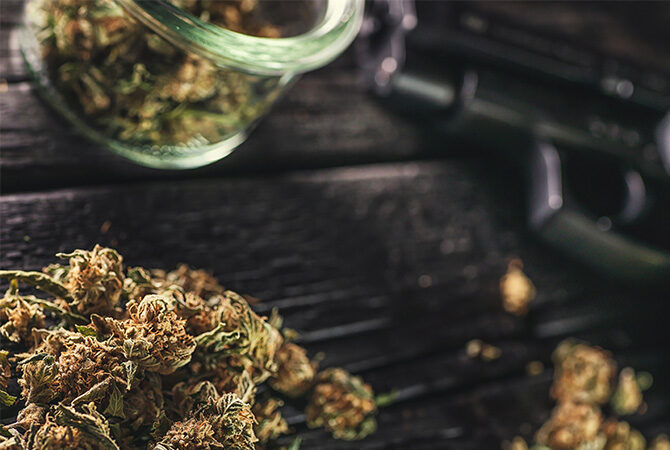
The Supreme Court announced Monday it will tackle a question affecting millions of Americans: Can people who regularly use marijuana legally own firearms?
The case pits two fundamental rights against each other—Second Amendment gun ownership and the growing acceptance of marijuana use—in a legal clash that could reshape civil liberties in an era where nearly half of U.S. states have legalized recreational cannabis while it remains federally prohibited.
The Case
The Trump administration is asking justices to revive charges against Ali Danial Hemani, a Texas man who admitted to regular marijuana use while possessing a firearm in his home. The 5th Circuit Court of Appeals dismissed his felony charge, ruling that the federal ban on gun ownership for drug users is unconstitutional under the Supreme Court's expanded interpretation of Second Amendment rights.
That 2022 landmark ruling established that firearm restrictions must have strong grounding in American history—a standard the appellate court found the drug-user gun ban fails to meet.
The Civil Liberties Clash
The case exposes a widening gap between state and federal law. Approximately 20% of Americans have tried marijuana, according to government health data, and roughly half of all states have legalized recreational use. Yet federal law still classifies marijuana as an illegal substance and prohibits anyone who uses it from owning guns.
Defense attorneys argue this creates a constitutional crisis: millions of otherwise law-abiding citizens who legally consume marijuana under state law face potential felony charges for exercising their Second Amendment rights. The 5th Circuit agreed, noting the government can only prosecute people who are simultaneously high and armed—not impose a blanket ban on sober marijuana users.
Competing Arguments
The Justice Department maintains the ban is a justified public safety measure. "Habitual illegal drug users with firearms present unique dangers to society," government attorneys argued, claiming they pose risks of armed confrontations while impaired.
In Hemani's specific case, the FBI also found cocaine during their search and alleged connections to Iranian Revolutionary Guard affiliates—though only the gun charge was filed. Defense lawyers contend these allegations are irrelevant attempts to make their client appear more dangerous.
Civil liberties advocates point out the inconsistency: alcohol users face no blanket prohibition on gun ownership, only restrictions on carrying while intoxicated. They question why marijuana should be treated differently, particularly as scientific understanding of cannabis evolves and states increasingly recognize it as safe for regulated use.
What's at Stake
The Supreme Court's decision, expected by June 2026, could affect gun rights for millions. It will test how far the Court's 2022 expansion of Second Amendment protections extends and whether federal drug prohibition can override state marijuana legalization.
The ruling may also impact pending cases nationwide where federal courts have reached conflicting conclusions on the same question—creating what the National Rifle Association calls "a confusing regulatory landscape" for Americans trying to exercise their constitutional rights.
As the nation continues debating both marijuana legalization and gun regulations, this case forces a reckoning: In a country where states are legalizing cannabis and courts are expanding gun rights, can the federal government still criminalize their combination?