So you've started growing cannabis, and now you're staring at rows of colorful bottles at the grow shop, completely overwhelmed. Should you go organic? Do you really need a dozen different supplements? And what the heck does NPK even mean?
Don't worry—feeding your cannabis plants doesn't have to be rocket science. In fact, most beginners make growing harder than it needs to be by overthinking nutrients. The truth is, cannabis plants are pretty forgiving if you stick to the basics.
In this complete guide, you'll learn exactly which nutrients your plants actually need, how to choose the best cannabis nutrients for beginners, and—most importantly—how to avoid the mistakes that kill plants during weeks 3-5 of growth (when nutrient problems typically strike hardest).
Let's dive in and demystify cannabis nutrition once and for all.
What Nutrients Do Cannabis Plants Actually Need?
Before we talk about brands and bottles, let's cover the fundamentals. Your cannabis plants need three primary nutrients, often called "macronutrients":
Nitrogen (N) - The growth engine. Nitrogen fuels leaf and stem development, keeping your plant vibrant green and healthy. Think of it as the protein of the plant world.
Phosphorus (P) - The flower power nutrient. Phosphorus is crucial for root development early on and becomes even more important during flowering when your plant is producing buds.
Potassium (K) - The strength builder. Potassium helps your plant regulate water, resist disease, and develop thick, dense flowers.
You'll see these three nutrients listed on every bottle as three numbers—that's the NPK ratio. A bottle labeled "10-5-7" contains 10% Nitrogen, 5% Phosphorus, and 7% Potassium.
Beyond the big three, cannabis also needs secondary nutrients (calcium, magnesium, sulfur) and micronutrients (iron, zinc, manganese, and others). The good news? Any quality nutrient line designed for cannabis will include everything your plants need.
Pro tip: Download the Grow Guide app to track your feeding schedule and get notifications when it's time to water and feed your plants. It takes the guesswork out of nutrient timing.
Understanding Cannabis Growth Stages and Nutrient Needs
Here's where beginners often get confused: cannabis plants need different nutrient ratios during different life stages. It's like how a growing teenager needs different nutrition than an adult.
Seedling Stage (Weeks 1-3)
Your tiny seedlings don't need much food yet. In fact, feeding too early is one of the most common mistakes beginners make.
What to do: If you're growing in quality soil, don't add any nutrients for the first 2-3 weeks. The soil contains enough food to get your seedlings started. If you're growing in an inert medium like coco coir, start with very diluted nutrients (about 1/4 strength).
NPK focus: Balanced or slightly higher nitrogen (like 5-5-5 or 7-4-5)
Vegetative Stage (Weeks 3-8+)
This is when your plant focuses on growing big, strong, and leafy. It's building the structure that will eventually support heavy buds.
What to do: Start feeding vegetative nutrients (higher in nitrogen) at half the recommended strength. Gradually increase if your plant looks pale or lime green.
NPK focus: High nitrogen (like 7-2-3 or 10-5-7)
Signs you need to increase feeding: Your plant looks pale green or yellowish overall, lower leaves are yellowing, growth seems slow.
Flowering Stage (Weeks 1-8+)
Once your plant starts producing flowers (buds), its nutritional needs shift dramatically. Too much nitrogen during flowering can actually reduce bud development and make your harvest taste harsh.
What to do: Switch to bloom nutrients (lower nitrogen, higher phosphorus and potassium). This typically happens when you flip your lights to 12/12 (for photoperiod plants) or when autoflowers naturally begin flowering.
NPK focus: Low nitrogen, high P and K (like 1-4-5 or 2-8-6)
Important: The Grow Guide app can help you identify exactly when to switch from vegetative to flowering nutrients based on your plant's stage. No more guessing!
Soil vs Hydro vs Coco: Choosing the Right Nutrients
Not all cannabis nutrients are created equal, and what works in soil might cause problems in hydroponics. Here's what you need to know:
Soil Nutrients
Designed to work with the natural ecosystem in your soil. Soil already contains some nutrients and beneficial microorganisms, so soil nutrients only provide supplemental nutrition.
Best for: Beginners who want a more forgiving growing experience. Soil acts as a buffer and is more forgiving of feeding mistakes.
Important note: Don't use soil nutrients in hydroponic systems—they don't provide complete nutrition.
Hydroponic Nutrients
These provide 100% of what your plant needs since there's no soil to supply additional nutrition. They work in any soilless medium.
Best for: Coco coir, deep water culture (DWC), and any hydroponic setup.
Bonus: Hydroponic nutrients can also be used in soil if you want faster growth, though it's not necessary.
Coco Coir Nutrients
Coco coir is technically a hydroponic medium (it contains zero nutrients), but some companies make nutrients specifically formulated for coco.
Best for: Growers using coco coir who want optimized results.
Alternative: You can also use regular hydroponic nutrients in coco with excellent results.
The 7 Best Cannabis Nutrients for Beginners
After helping thousands of growers get started, these are the nutrient lines we recommend most often. They're proven, beginner-friendly, and won't break the bank.
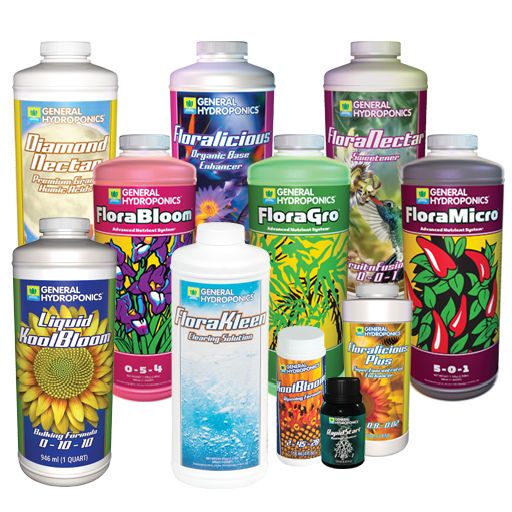
1. General Hydroponics Flora Trio
Works in: Soil, Coco, Hydroponics
Why beginners love it: This three-bottle system (FloraGro, FloraMicro, FloraBloom) is incredibly versatile and has been a staple in the cannabis community for decades. It's affordable, widely available, and virtually impossible to screw up if you follow the instructions.
Price point: Budget-friendly
Pro tip: Start at half strength and follow the feeding schedule on the bottle. If growing in hydroponics, add Hydroguard to prevent root rot.
What you need: Flora Trio bottles (all three), optional Cal-Mag if using filtered water or growing under LEDs
2. Fox Farm Trio
Works in: Soil, Coco
Why beginners love it: Fox Farm's "Grow Big," "Big Bloom," and "Tiger Bloom" contain organic ingredients like earthworm castings and bat guano, which many growers believe produces better-tasting buds. The results are consistently impressive.
Price point: Mid-range
Important: Fox Farm is concentrated—use half strength to start. There are different versions for soil vs hydro/coco, so make sure you grab the right one.
What you need: All three bottles in the trio, optional Cal-Mag for coco growing
3. Dyna-Gro Foliage Pro + Bloom
Works in: Soil, Coco, Hydroponics
Why beginners love it: This is the simplest system on our list—just two bottles. Use Foliage Pro during veg, switch to Bloom during flowering. Done. Originally designed for orchids, but cannabis growers discovered it works beautifully for weed.
Price point: Very budget-friendly
Perfect for: Beginners who want results without complexity.
What you need: Just the two bottles—seriously, that's it!
4. Canna Coco A+B
Works in: Coco Coir (specifically designed for it)
Why beginners love it: If you're growing in coco, this is the gold standard. Canna has been testing on actual cannabis plants for decades, and it shows. Many coco growers refuse to use anything else.
Price point: Mid to higher range
What you need: Canna Coco A+B bottles, optional Cal-Mag
5. Botanicare KIND
Works in: Coco, Hydroponics
Why beginners love it: The three-bottle system (Base, Grow, Bloom) gives you more control over nitrogen and calcium levels than most nutrient lines. Great for intermediate beginners who want to level up.
Price point: Mid-range
What you need: All three bottles, Hydroguard if growing in hydro
6. Advanced Nutrients pH Perfect
Works in: Soil, Coco, Hydroponics
Why beginners love it: The "pH Perfect" technology automatically adjusts your pH, which is a game-changer for beginners who struggle with pH management (more on that below).
Price point: Higher end
Important: The base nutrients are reasonably priced, but Advanced Nutrients sells tons of supplements. Stick to just the base nutrients for your first grow—you don't need the supplements.
What you need: The three-part base nutrients (Grow, Micro, Bloom)
7. Jack's Nutrients (Classic 20-20-20 + Blossom Booster)
Works in: Soil primarily
Why beginners love it: Dry nutrients that cost pennies per gallon and last forever. If you're on a tight budget, this is your answer.
Price point: Extremely budget-friendly
Trade-off: Less convenient to mix than liquid nutrients, and you'll need to be more careful with measurements.
What you need: Jack's Classic 20-20-20 for veg, Blossom Booster 10-30-20 for flowering
Do You Really Need Supplements?
Walk into any grow shop and you'll be bombarded with supplements promising bigger yields, frostier buds, and denser flowers. Here's the honest truth: base nutrients are all you need to grow exceptional cannabis.
Supplements can be helpful in specific situations, but they're not necessary for beginners. In fact, adding too many supplements is a common way beginners accidentally burn their plants or waste money.
Supplements Worth Considering (Eventually)
Cal-Mag - Useful if you're growing in coco coir, using filtered/RO water, or growing under LED lights. These situations increase calcium and magnesium needs.
Hydroguard (or similar root inoculant) - Essential if you're growing in hydroponic systems with water reservoirs. It prevents root rot and promotes healthy root development.
Silica supplements - Can help strengthen stems and increase heat resistance, but not necessary for your first grow.
The Golden Rule on Supplements
Stick to one nutrient brand, and if you do add supplements, only add them from the same company. Mixing brands increases the chance of nutrient lockout and unhappy plants.
The Grow Guide app's plant health diagnostic system can help you determine if you actually need supplements or if you're dealing with a different issue entirely. Often what looks like a deficiency is actually a pH problem (more on that next).
The pH Problem That Kills Most Beginner Grows
Here's something that surprises most beginners: you can have all the right nutrients in your water, but if your pH is wrong, your plant can't absorb them. It's like having a feast laid out but your plant's mouth is wired shut.
Incorrect pH is the #1 cause of nutrient deficiencies, even when nutrients are present.
Optimal pH Ranges
Soil growing: 6.0 - 7.0 (slightly acidic to neutral)
Coco coir: 5.5 - 6.5 (slightly acidic)
Hydroponics: 5.5 - 6.5 (slightly acidic)
How to Check and Adjust pH
Step 1: Get a pH meter. Digital pH pens are affordable (around $15-30) and accurate. Test strips work but are less precise.
Step 2: Mix your nutrients into your water first, then test the pH.
Step 3: Adjust using pH Up or pH Down products (available at any grow shop or online).
Step 4: Test again to confirm you're in the right range.
Pro tip: Let your pH fluctuate within the optimal range rather than trying to hit the exact same number every time. This ensures your plant can access all nutrients, as different nutrients are available at slightly different pH levels.
Even easier: Use the Grow Guide app to log your pH readings and get alerts if you're drifting out of range. It also includes a nutrient deficiency diagnostic tool that can help identify if pH is causing your problems.
Common Beginner Nutrient Mistakes (And How to Avoid Them)
Mistake #1: Overfeeding
The problem: Most nutrient companies recommend way too much for cannabis. Following their directions often leads to nutrient burn—crispy, brown leaf tips that make your plant look sad.
The solution: Always start at half the recommended strength. Only increase if your plant looks pale overall. If leaves are green and growth is steady, you're feeding enough.
How to spot it: Brown, crispy tips on leaves, dark green leaves with clawed tips, stunted growth.
Mistake #2: Feeding Too Early
The problem: Those cute little seedlings don't need food yet. Quality soil has enough nutrients for the first few weeks, and tiny plants can't handle full-strength nutrients.
The solution: Wait until week 3-4 before starting nutrients in soil. In coco or hydro, start with very diluted nutrients (1/4 strength) and gradually increase.
Mistake #3: Not Checking pH
The problem: You can have perfect nutrients, but wrong pH locks them out. Your plant shows deficiency symptoms even though you're feeding it.
The solution: Check pH every single time you water. Yes, every time. It takes 30 seconds and prevents 90% of nutrient problems. Get yourself a reliable pH pen—it's the best $20 you'll spend on your grow.
Mistake #4: Using Tap Water Without Testing
The problem: Some tap water is great for cannabis. Some is terrible (too high pH, high PPM, chlorine/chloramine). You won't know unless you test.
The solution: Test your tap water's pH and PPM/EC. If your water is above 300 PPM or pH is very high/low, consider filtering it or using Cal-Mag to stabilize it.
Mistake #5: Mixing Nutrient Brands
The problem: Different brands use different ingredient combinations. Mixing them can cause unexpected reactions, lockout, or toxicity.
The solution: Pick one nutrient line and stick with it. If you use supplements, get them from the same company as your base nutrients.
Mistake #6: Ignoring Your Plant
The problem: Following a rigid feeding schedule without looking at your plant. Schedules are guidelines—your plant tells you what it actually needs.
The solution: Learn to read your plants. Pale green = needs more food. Dark green with burned tips = too much food. Healthy green = you're doing great.
Need help? The Grow Guide app includes a plant health diagnostic feature where you can upload photos and get specific advice on nutrient issues.
Organic vs Synthetic Nutrients: Which Is Better for Beginners?
This is one of the most common questions we get, and the answer might surprise you: neither is "better"—they're just different.
Synthetic (Mineral-Based) Nutrients
Pros:
- Faster growth and bigger yields
- More precise control
- Work in any growing medium including hydroponics
- Generally cheaper
- Easier to correct deficiencies quickly
Cons:
- Easier to overfeed and burn plants
- Some growers believe they produce less flavorful buds (debatable)
- Can harm beneficial soil microorganisms if used in living soil
Best for: Beginners growing in coco or hydroponics, or anyone who wants fast growth and maximum yields.
Organic Nutrients
Pros:
- Many growers swear by the superior smell and taste
- More forgiving (harder to burn plants)
- Builds healthy soil ecosystem
- More environmentally friendly
Cons:
- Slower nutrient uptake = slightly slower growth
- Not suitable for hydroponics (can cause root issues)
- Often more expensive
- Takes longer to correct deficiencies
Best for: Soil growers who prioritize flavor and don't mind slightly slower growth.
Our Beginner Recommendation
For your first grow, we typically recommend synthetic or mineral-based nutrients for a few reasons:
- They're more forgiving of beginner mistakes (you can fix problems quickly)
- They work in any medium, giving you flexibility
- They're generally more affordable
- The learning curve is gentler
Once you've got a successful harvest or two under your belt, experiment with organic growing if the philosophy appeals to you.
How Much Does It Cost to Feed Cannabis Plants?
Budget is a real concern for many beginners, so let's break down actual costs:
Basic setup (enough for 2-4 plants through a complete grow):
- Budget option (Dyna-Gro or Jack's): $25-40
- Mid-range option (GH Flora Trio, Fox Farm): $40-70
- Premium option (Advanced Nutrients, House & Garden): $80-150
Additional costs:
- pH test kit or pen: $15-50 (one-time purchase)
- pH Up/Down: $15-25 (lasts multiple grows)
- Optional Cal-Mag: $15-25 (if needed)
Bottom line: You can feed cannabis plants through a complete grow for $50-75 including pH testing supplies. That's less than what you'd pay for a quarter ounce at a dispensary, and you're going to harvest way more than that.
Feeding Schedule Basics: When and How Often
One of the biggest questions beginners have: how often should I feed my plants?
The answer depends on your growing medium:
Soil Growing
Feeding frequency: Every other watering, or roughly 1-2 times per week
Why: Soil retains nutrients, so you don't need to feed every time. Alternate between plain pH'd water and nutrient solution.
Schedule example:
- Monday: Feed with nutrients
- Thursday: Plain water
- Sunday: Feed with nutrients
- Wednesday: Plain water
Coco Coir Growing
Feeding frequency: Every watering (daily to every other day)
Why: Coco doesn't retain nutrients like soil, so plants need food more frequently.
Important: Always use nutrients in coco—don't give plain water except during the final flush.
Hydroponic Growing
Feeding frequency: Continuous (nutrients stay in the reservoir)
Maintenance: Change reservoir weekly, top off with pH'd water between changes, monitor pH daily.
How Much Nutrient Solution to Give
General rule: Water until you get 10-20% runoff from the bottom of your container. This prevents salt buildup and ensures the entire root zone gets fed.
Amount per plant:
- Small plants (seedlings): 1/4 - 1/2 cup
- Young vegetative plants: 1-2 cups
- Large vegetative plants: 1-2 quarts
- Flowering plants: 1-2+ quarts (they drink more during flowering)
Pro tip: The Grow Guide app can remind you when it's time to water and feed based on your specific setup and plant stage.
Reading Your Plants: Signs You're Doing It Right (Or Wrong)
Cannabis plants are pretty good at telling you what they need—if you know what to look for.
Signs of Healthy, Well-Fed Plants
- Vibrant green leaves (not pale, not dark)
- New growth is slightly lighter green than older growth (normal)
- Leaves pointing up or slightly out (praying)
- Steady, consistent growth
- Strong stems
- No yellowing, spotting, or discoloration
Signs of Underfeeding
- Overall pale or lime green color
- Yellowing starts on lower, older leaves and moves up
- Slow growth
- Thin, weak stems
- Small leaves
Fix: Increase nutrient strength by 25% and monitor for improvement.
Signs of Overfeeding (Nutrient Burn)
- Brown, crispy leaf tips
- Dark green leaves with clawed or curled tips
- Burnt edges on leaves
- Yellowing between leaf veins
- Stunted growth
Fix: Flush with plain pH'd water (2-3x the container volume), then resume feeding at half strength.
Signs of pH Problems
- Nutrient deficiency symptoms even though you're feeding properly
- Multiple deficiencies appearing at once
- Spotting or discoloration that doesn't improve with feeding
- Slow, stunted growth
Fix: Check and adjust pH. Most "deficiencies" are actually pH lockout.
Need help diagnosing? The Grow Guide app includes a visual diagnostic tool and AI-powered plant health analysis. Just snap a photo and get specific recommendations.
The Final Flush: Preparing for Harvest
About 7-14 days before harvest, many growers stop feeding nutrients and give only plain, pH'd water. This is called "flushing," and it helps remove excess nutrients from the plant and improve the final taste of your buds.
How to flush:
- Stop all nutrients 1-2 weeks before harvest
- Give plain, pH'd water every time you water
- Water until you get significant runoff (30-50%)
- Continue until harvest
Signs it's working: Leaves will naturally yellow as the plant uses up stored nutrients. This is normal and desirable during the flush.
Debate alert: Some growers swear by flushing, others say it doesn't make a difference. We recommend trying it—worst case, it doesn't help. Best case, your buds taste noticeably smoother.
For more details on harvest timing and preparation, check out the Cannabis Harvest Timing Guide on Grow Guide.
Quick-Reference Nutrient Chart
| Growth Stage | NPK Ratio | Feeding Frequency | Key Tips |
|---|---|---|---|
| Seedling (Week 1-3) | None or 5-5-5 | None in soil; 1/4 strength in coco/hydro | Don't overfeed! Less is more |
| Vegetative (Week 3+) | 7-2-3 to 10-5-7 | Soil: every other watering; Coco/Hydro: every watering | High nitrogen for growth |
| Early Flowering (Week 1-3) | 5-7-7 | Same as veg | Transition nutrients |
| Peak Flowering (Week 3-6) | 1-4-5 to 2-8-6 | Same as veg | Low N, high P&K |
| Late Flowering (Week 6-harvest) | 0-3-3 or flush | Reduce feeding, then flush | Prepare for harvest |
Your Next Steps: From Nutrients to Harvest
Congratulations! You now know more about cannabis nutrients than 90% of beginners. But growing great weed isn't just about feeding—it's about understanding your plant's entire lifecycle.
Keep learning:
- Why New Growers Kill Plants in Weeks 3-5 – Learn to spot and fix problems before they kill your plants
- Growing Cannabis Indoors – Complete setup guide for indoor cultivation
- Drying & Curing Guide – Don't ruin a great harvest with bad post-harvest technique
- Plant Health Diagnostic System – Instant plant problem identification
Get the Grow Guide App: Stop guessing and start growing with confidence. Get personalized feeding schedules, pH tracking, problem diagnosis, and reminders so you never forget to water. Available for iOS and Android.
Remember: every expert grower was once a beginner who probably killed a plant or two. The key is learning from mistakes, staying observant, and keeping things simple. Your plants want to grow—your job is just to give them what they need and stay out of their way.
Final Thoughts: Keep It Simple, Stupid (KISS Method)
After working with thousands of beginner growers, here's what we've learned: the growers who succeed aren't the ones with the most expensive nutrients or the most complicated feeding schedules. They're the ones who:
- Pick a quality nutrient line and stick with it
- Start at half strength
- Check pH every single time
- Watch their plants and adjust based on what they see
- Don't panic and overcorrect at the first sign of trouble
Cannabis is a resilient plant. Give it decent nutrients, proper pH, adequate light, and it will reward you with beautiful buds.
The nutrients you choose matter less than consistency, observation, and patience. So pick a nutrient line from this guide, follow the instructions at half strength, check your pH, and trust the process.
Your first harvest is closer than you think—and it's going to be worth every bit of effort you put in.
Happy growing!
Frequently Asked Questions
Q: Can I use Miracle-Gro or other general plant nutrients for cannabis?
A: We don't recommend it. Miracle-Gro time-release nutrients can't be adjusted for different growth stages and often contain too much nitrogen during flowering. Cannabis-specific nutrients are formulated for the plant's changing needs and aren't much more expensive.
Q: How do I know if I need Cal-Mag?
A: Cal-Mag is helpful if you're growing in coco coir, using filtered/RO water, or growing under LED lights. Signs you need it include rust spots on leaves, slow growth, and leaf edges turning brown. However, many nutrient lines include enough calcium and magnesium, so don't assume you need it.
Q: Can I switch nutrient brands mid-grow?
A: It's not ideal, but yes. If you must switch, flush your plants with plain pH'd water first, then start the new nutrients at half strength. Switching can cause temporary stress, so only do it if you have a good reason.
Q: What's the difference between PPM and EC?
A: Both measure nutrient concentration in your water. PPM (parts per million) and EC (electrical conductivity) tell you how strong your nutrient solution is. Most beginners don't need to worry about this initially—just follow the bottle instructions at half strength.
Q: Should I feed every time I water?
A: It depends on your medium. In coco and hydro, yes. In soil, no—alternate between nutrient solution and plain pH'd water.
Q: What if my plant has multiple deficiencies at once?
A: This is almost always a pH problem, not a feeding problem. Check your pH first before changing your feeding routine. Use the Grow Guide app's diagnostic tool to identify the issue.
Q: How long do nutrients last once opened?
A: Most liquid nutrients last 1-2 years if stored properly (cool, dark place). Dry nutrients can last years. Check for crystallization or separation—if it looks weird or smells off, replace it.
Related Articles:
- Diagnose & Fix Nutrient Deficiency
- Natural Pest Control for Cannabis
- Science of Terpenes: What Makes Your Weed Smell Amazing
- Cannabis Strain Selection Guide
Download Grow Guide Today and take the guesswork out of growing. Track your nutrients, diagnose problems instantly, and grow with confidence from seed to harvest.