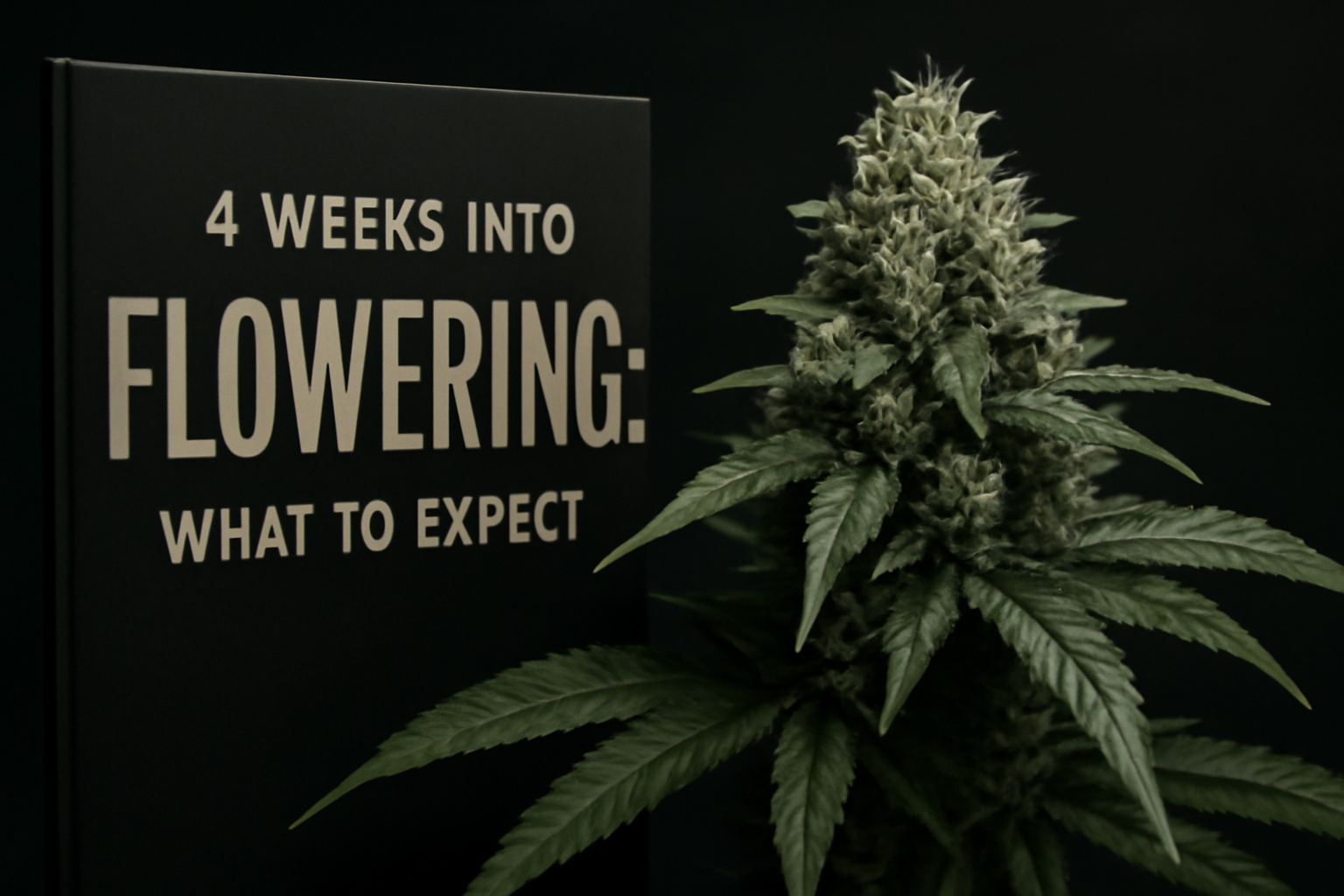
What 4 Weeks Into Flowering Actually Looks Like
If you're searching for "4 weeks into flowering pictures," you want to know whether your plant looks right. Here's the honest answer: there's a wide range of normal, but there are clear benchmarks every healthy plant should hit by day 28 of flower. Buds should be clearly defined at all main colas, white pistils should be dense and outward-reaching, and a faint-to-moderate trichome shimmer should be visible to the naked eye under good light. If you're not seeing that, something's off — and this guide will help you find it.
Based on data from over 1,000 grow journals tracked on Grow Guide, 73.7% of growers are running indoor setups — meaning controlled environments where dialing in week 4 variables is entirely in your hands. There's no weather excuse. Let's get into what your plant should look like, what it needs, and what to fix if things aren't progressing correctly.
Bud Development at Week 4: The Visual Checklist
Week 4 of flowering is sometimes called the "transition to bulk" phase. The stretch is done or nearly done (most indica-dominant strains stop stretching by day 21; sativas can keep going to day 28–35). What you should be seeing right now:
- Dense pistil coverage: White hairs should be thick and curling outward from every bud site. No amber yet — that comes later.
- Calyx stacking: Individual calyxes are beginning to pile on top of each other, giving colas a lumpy, building appearance.
- Trichome shimmer: Under a loupe or jeweler's scope (60–100x), you should see clear, glass-like trichome heads on bracts and sugar leaves. Milky trichomes at week 4 are early — not a bad sign on fast-finishing strains.
- Resin aroma: The smell should be noticeably stronger than week 2. The specific terpene profile depends on genetics — use the Terpene Explorer to track what you're smelling against the strain's expected profile.
- Fan leaves yellowing slightly: Minor lower-leaf yellowing from nitrogen drawdown is normal and expected. Aggressive yellowing moving up the plant is not.
If your buds look like small, wispy clusters of pistils with no calyx structure forming underneath, you may be dealing with light intensity issues, a nitrogen lockout preventing energy transfer, or a light leak disrupting the 12/12 cycle.
Environment Settings at 4 Weeks Into Flowering
Week 4 is when environmental precision starts to pay dividends. Here are the exact numbers to hit:
| Parameter | Target Range | Warning Zone |
|---|---|---|
| Temperature (lights on) | 68–77°F (20–25°C) | >82°F causes terpene loss |
| Temperature (lights off) | 62–68°F (17–20°C) | <60°F slows metabolism |
| Relative Humidity | 40–50% | >55% = botrytis risk starts |
| VPD | 1.0–1.5 kPa | <0.8 = transpiration stalls |
| CO₂ (ambient) | 400–800 ppm | Supplementing? Stay ≤1500 ppm |
| PPFD (canopy) | 600–900 µmol/m²/s | >1000 without CO₂ = light stress |
Humidity is the variable most growers let slip at this stage. As buds thicken, airflow inside the canopy drops and moisture pockets form. Run oscillating fans at canopy level and underneath — not just blowing across the top. Check your Grow Light Calculator to confirm your PPFD is hitting target at canopy level, not just what the manufacturer claims at a fixed hanging height.
Nutrients at Week 4 of Flower: Shift to P and K
Your nutrient profile should have already transitioned away from high-nitrogen grow formulas. By week 4 you want a bloom-heavy feed with significantly reduced N and elevated phosphorus (P) and potassium (K). Here's what that looks like in practice across common mediums:
In terms of EC targets by medium:
- Soil: EC 1.4–1.8 mS/cm. Soil buffers well, so keep feeds moderate and consistent. pH 6.2–6.8.
- Coco coir: EC 1.6–2.2 mS/cm. Coco growers (14.9% of Grow Guide users) can push harder — feed daily to runoff at 10–20%. pH 5.8–6.2.
- Hydro/DWC: EC 1.4–1.8 mS/cm. pH 5.5–6.1. Oxygenation critical — DO above 6 mg/L.
Watch for the two most common week-4 feeding errors: nutrient burn (brown, crispy leaf tips, usually from EC creep in coco or hydro) and phosphorus deficiency (purpling of lower stems and leaves, dull coloration on buds). If you're not sure which one you're looking at, run it through the Nutrient Deficiency Identifier before adjusting anything — guessing wrong and overcorrecting is how you create a bigger problem.
For organic growers, week 4 is peak compost tea and topdressing time if you're running a living soil setup. A molasses-based bloom tea at 1–2 tsp/gallon fed every 7–10 days feeds the microherd that in turn makes P and K plant-available. See our Best Organic Nutes for Cannabis guide for specific product timing.
4 Weeks Into Flowering: Troubleshooting the Most Common Problems
Buds Are Airy and Not Stacking
Primary causes: insufficient PPFD (below 600 µmol/m²/s at canopy), temperatures too high (>82°F), or heat stress from lights hung too close. Check your hanging distance and verify with a PAR meter. Insufficient DLI is the silent yield killer — your total daily light integral at week 4 should be 35–45 mol/m²/day. Anything below 30 and you're leaving density on the table.
Leaves Are Yellowing Fast
Some lower-leaf senescence is expected — the plant is deliberately pulling nitrogen from older tissue. If yellowing is climbing to mid-canopy or hitting bud leaves, you've over-tapered N too aggressively. Add a small nitrogen boost (1/4 strength) through an amino acid supplement like a kelp extract rather than going back to grow formula. Keep bloom P/K ratios intact.
White Powdery Residue on Leaves
Powdery mildew. At 40–50% RH it's unusual but not impossible, especially if airflow is poor inside a dense canopy. Act immediately: potassium bicarbonate spray (1 tbsp/gallon) on all affected surfaces during lights-on period. Remove heavily infected leaves. This is not something you can outrun — it will spread to buds within days if left unchecked.
Pistils Turning Amber Already
At week 4, early pistil browning is almost never a sign of harvest readiness — it's usually heat or physical stress (branches rubbing, water touching flowers). Check temps and airflow first. If a whole cola is turning amber while others are still white, check for light burn directly above that site.
Light Leaks
If your plant looks confused — throwing new single-finger fan leaves, showing irregular growth or reverting toward vegetative structure — you have a light leak in your dark period. Inspect the tent or room with all external lights off and let your eyes adjust for 60 seconds. Even a pinhole of light can disrupt the photoperiod signal on sensitive strains. Light leaks at week 4 can cause herming in genetically susceptible plants.
Support and Canopy Management at Week 4 Into Flowering
Stop major defoliation by the end of week 3. At week 4, the only leaf removal you should be doing is selective: remove leaves that are directly blocking bud sites or sitting flat against developing calyxes trapping moisture. Heavy defoliation at this point redirects plant energy to recovery rather than bud development.
Branch support is now urgent on heavier-yielding cultivars. If you didn't install a trellis net during veg, use individual bamboo stakes or soft plant ties now. Branches loaded with developing colas will pull stems at angles that restrict vascular flow — you'll notice those buds fatten slower and finish later than supported ones. Use your Grow Schedule Planner to set reminders for daily inspection and staking through the remainder of flower.
Thinking Ahead: From Week 4 to Harvest
Most photoperiod strains have 4–6 weeks remaining after week 4. Autoflowers on a typical 70–80 day total timeline may only have 2–3 weeks left. Start thinking now about your flush strategy (if you use one), harvest timing, and your dry/cure setup.
Trichome monitoring should become part of your weekly routine from week 4 onward. Clear trichomes = not ready. Milky/cloudy = peak THC, more energetic effect. Amber = THC degrading to CBN, more sedative. Most growers target 10–20% amber for a balanced harvest. For a detailed look at how long the full process takes from seed to jar, see How Long to Grow Cannabis Indoors.
When you're ready to chop, have your dry room dialed before harvest day. Target 60–65°F, 55–60% RH for a slow 10–14 day dry that preserves terpenes. Then move to cure. Use the Dry & Cure Timer to track both phases. A rushed dry at this stage will undo everything you've optimized over the last 4 weeks.
Want to estimate what your current canopy should yield? Plug your setup details into the Yield Calculator now — week 4 is a good checkpoint to compare projected vs. actual bud development and adjust expectations for the back half of flower.
Frequently Asked Questions
What should cannabis look like at 4 weeks into flowering?
By week 4, buds should have clear calyx structure forming at all main colas, dense white pistils, and a visible trichome shimmer. The stretch should be complete or nearly done. Airy, wispy bud sites with few trichomes at week 4 indicate a light or nutrient issue that needs addressing immediately.
How much longer until harvest at 4 weeks into flowering?
For most photoperiod indica-dominant strains (8–9 week flower), you have 4–5 weeks remaining. Sativa-dominant strains (10–12 weeks) may have 6–8 weeks left. Autoflowers depend entirely on the cultivar — check the breeder's stated flower time and monitor trichomes from week 5 onward.
What nutrients should I be feeding at week 4 of flower?
A bloom-specific formula with low nitrogen and high phosphorus and potassium. Target EC 1.6–2.0 mS/cm in coco or soil, pH 5.8–6.5 depending on medium. Avoid high-nitrogen grow formulas completely — excess N at week 4 suppresses resin production and delays maturation.
Is it normal for fan leaves to yellow at week 4 of flowering?
Yes — lower fan leaf yellowing from nitrogen mobilization is a normal part of flowering. The plant pulls N from older leaves to fuel flower production. It becomes a problem when yellowing moves rapidly up the plant toward mid-canopy or affects leaves directly attached to bud sites.
What humidity should I maintain at 4 weeks into flowering?
Keep relative humidity between 40–50% at week 4. As buds develop density through weeks 5–7, drop humidity further toward 35–45% to reduce botrytis risk. If your room is running consistently above 55% RH with thickening buds, add a dehumidifier — mold at this stage can destroy an otherwise excellent harvest.